Chapter 14
The Money
The AI buildout is one of the largest waves of capital spending in history, and the question hanging over all of it is simple to ask and hard to answer — will the money spent building it be earned back?
The Scale of the Spend
First, two words to define, because they are the key ones. Capex, short for capital expenditure — the money a company spends building or buying long-lived assets like buildings and machines, as opposed to day-to-day running costs (called opex, operating expenditure) like electricity and salaries. The AI buildout is, at its heart, a capex story of historic size — but it will eventually become an opex story too, because the electricity bills, maintenance costs, and staffing expenses of running all this infrastructure will persist for decades after the buildings are built.
The distinction matters because capex and opex have different economic rhythms. Capex is lumpy — you spend billions in a short period to build a facility, and then it's done. Opex is steady — the electricity bill arrives every month for as long as the facility runs. A company can handle a large one-time capex investment if it has the cash or can borrow; handling the ongoing opex requires steady revenue. The question for the AI buildout is whether both the upfront investment and the ongoing operating costs can be justified by the revenue the infrastructure generates.
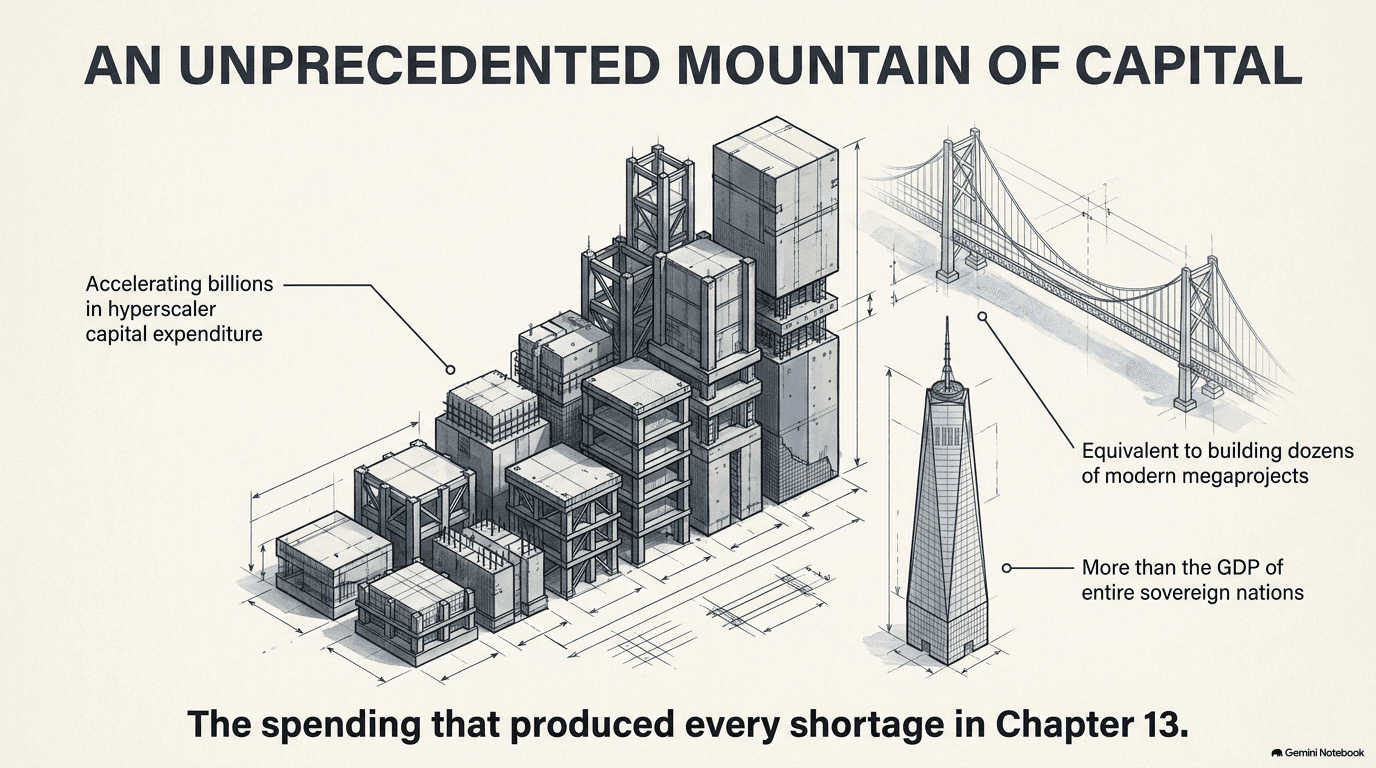
The headline figure is the combined capital spending of the hyperscalers (Chapter 12), which has been estimated to be climbing toward hundreds of billions of dollars per year — and that estimate has risen sharply over a short period. To put that in perspective: the annual capital spending of these few companies exceeds the entire annual economic output of most countries. It is larger than the investment in the original transcontinental railroad, the interstate highway system, or the first build-out of the internet, adjusted for inflation. It is the reason every supplier in this book — from the copper miners to the transformer makers to the fiber factories — is reporting record backlogs simultaneously. When that much money moves through a supply chain at once, it produces exactly the shortages and lead times described in Chapter 13.
The spending is not evenly distributed. The hyperscalers account for the largest share — they are both the builders and the biggest customers. The NeoClouds and crypto-pivots are financed differently (section 14.2), and the upstream suppliers (the equipment makers, the construction companies, the material producers) are themselves investing heavily to expand their own capacity, which creates a secondary wave of spending on top of the primary one.
This secondary wave is easy to miss but significant. The semiconductor equipment makers from Chapter 9 are building new factories to increase tool production. The transformer makers from that same chapter are expanding their manufacturing lines. The copper miners from Chapter 10 are developing new deposits. The construction companies from Chapter 13 are hiring and training at maximum speed. Each of these expansions costs billions of its own and takes years to complete — and each one was triggered by the primary spending wave. The capital flowing through the system is not just the headline number; it's the headline number plus all the investments required to produce the things the headline number is buying.
The spending is also geographically uneven in ways that create their own dynamics. Data centers are concentrating in regions with available power, favorable permitting, and cold climates (for lower cooling costs) — northern Virginia, central Texas, the Nordic countries, parts of the American Midwest. This creates local investment booms: construction jobs, housing demand, school enrollment, tax revenue — and local resistance (section 13.2 of Chapter 13). A region that attracts tens of billions of dollars in data-center investment experiences the economic equivalent of a gold rush, with both the benefits and the strains that implies. A region that doesn't attract this investment — perhaps because its grid is congested, its permitting is slow, or its power costs are high — misses out entirely. The geographic concentration of AI infrastructure spending is creating economic winners and losers at the state, county, and even town level.
One historical comparison is useful: the railroad boom of the mid-nineteenth century didn't just produce railroads. It produced the steel mills to make the rails, the locomotive factories to make the engines, the telegraph network that ran alongside the tracks, and the towns that sprang up at every stop. The AI buildout is producing a similar cascade of upstream investment — and the question of whether that cascade is sustainable is, ultimately, the question of this chapter.
Who's Paying
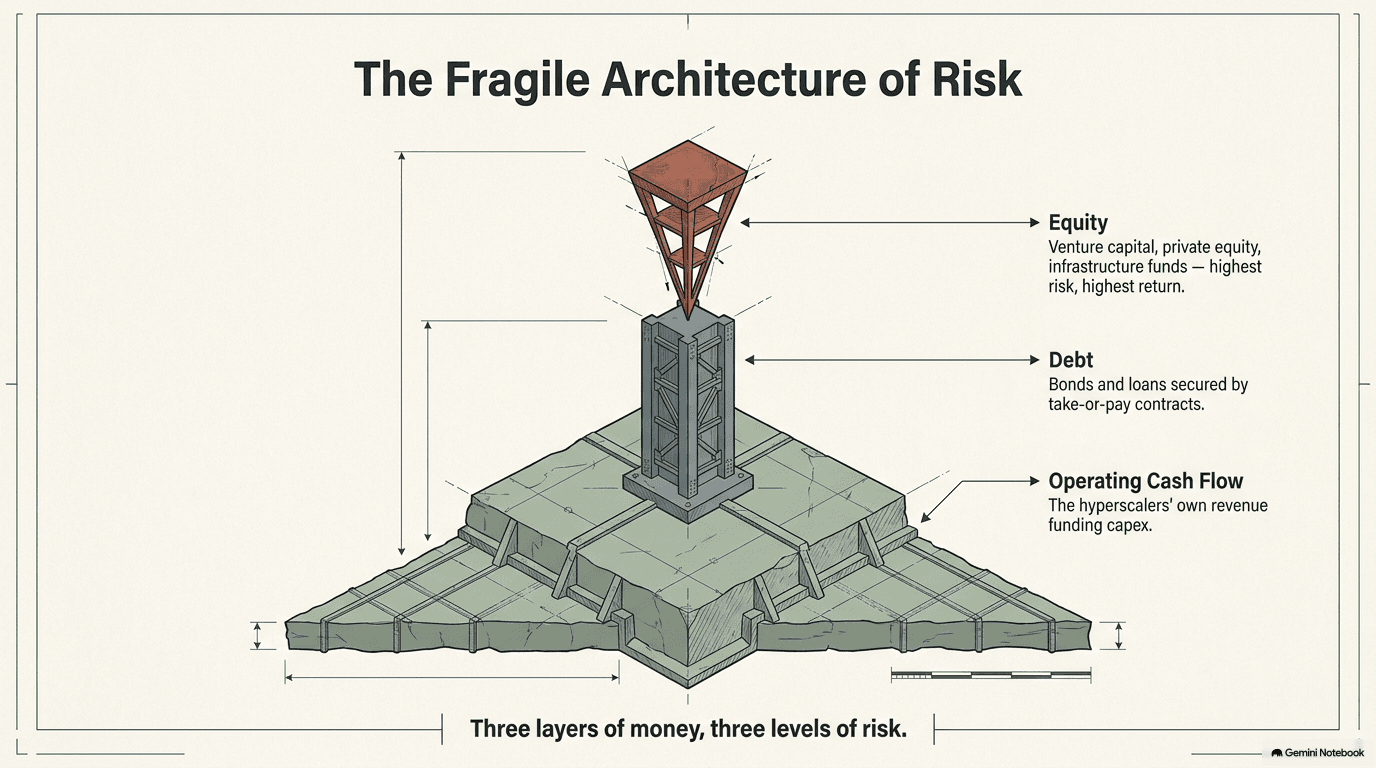
The money comes from three places, layered on top of each other.
The first is the hyperscalers' own cash flow. The largest cloud companies are extraordinarily profitable, and they are pouring those profits directly into infrastructure. This is the sturdiest funding source, because it doesn't depend on borrowing or on external investors' confidence — the companies are spending money they've already earned.
The second is debt — borrowed money. The newer operators (the NeoClouds and crypto-pivots from Chapter 12) can't fund tens of billions from profits they don't yet have, so they borrow against their contracts. This is where the take-or-pay structure from section 12.4 becomes essential.
The mechanism works like this. A customer — typically a hyperscaler or a well-funded AI company — signs a contract committing to pay for a certain amount of compute capacity for ten or fifteen years, regardless of whether they use it. This contract is, in financial terms, a predictable stream of future cash flows. The operator takes this contract to a bank or bond market and says: "This creditworthy customer will pay me a fixed amount per year for fifteen years. Lend me the money to build the facility, and I'll repay you from those payments." The lender assesses the risk: how creditworthy is the customer? How likely is it that the customer will actually pay for the full term? How well-constructed is the facility? What happens if the customer defaults — can the facility be re-leased to someone else?
Three independent agencies — Moody's, S&P, Fitch — exist for the sole purpose of assessing how safe a bond is. They assign letter grades, just like school. The key threshold is investment-grade — a rating of BBB- or higher (there are finer gradations above that, running through A and AA up to AAA at the top). Why does this matter? Because the largest pools of money in the world — pension funds managing retirement savings, insurance companies holding policyholder premiums — are only allowed to buy investment-grade debt. A rating above that line opens a vastly larger market of buyers, which means the operator can borrow more cheaply. A rating below that line (called "high-yield" or, less diplomatically, "junk") means higher interest rates because fewer buyers are willing to take the risk. This is the same mechanism, project finance, that has funded toll roads, pipelines, power plants, and cell towers for decades, applied to a new asset class. The novelty is the asset: a building full of GPUs that depreciate fast and serve a market that didn't exist a decade ago.
The third is private capital — the venture-capital funds, private-equity firms, sovereign-wealth funds, and infrastructure investors putting equity into the operators, the power plants, and the fiber networks. These investors provide the capital that sits beneath the debt — the money at risk if the project fails — and in return they expect the highest returns.
To understand these three layers, think of them as a sandwich. The top layer — the hyperscalers' cash flow — is the most resilient; it comes from companies that are already profitable and don't need external funding to survive. The middle layer — debt — is durable as long as the contracts backing it hold; a bank that lent against a fifteen-year take-or-pay contract will be repaid even if the AI market goes sideways, as long as the customer remains solvent. The bottom layer — private equity — bears the most risk; if the project fails, equity investors are the last to be repaid and may lose everything. But they also capture the most upside if the project succeeds.
The size of each layer varies by project. A hyperscaler building its own data center uses mostly its own cash — perhaps 80% equity and 20% debt, or no debt at all, because it doesn't need to borrow. A NeoCloud building under a take-or-pay contract might use 30% equity and 70% project-finance debt, because the contract provides the predictability that lenders require. A crypto-pivot converting an existing facility might use a mix of all three: some equity from infrastructure investors, some debt against its power contracts, and some cash from its existing mining operations. The capital structure determines who profits and who loses under different scenarios — and it determines how fast the operator can build, because a company that can borrow cheaply against strong contracts can grow faster than one that must fund everything from its own earnings.
The involvement of infrastructure-focused investors is notable and worth understanding, because it signals a meaningful shift in how the market views AI data centers. Venture capital has always invested in technology companies. Private equity has invested in real estate and industrial assets. Infrastructure funds have invested in toll roads, pipelines, airports, and power plants. What's new is that infrastructure funds — whose whole thesis is patient, decades-long ownership of essential assets with predictable cash flows — are now investing in GPU data centers. This signals that the market is beginning to view AI compute infrastructure not as a speculative technology bet but as a long-lived, utility-like asset class: something that will be needed for decades, regardless of which specific AI companies succeed or fail.
There is a fourth source of capital that doesn't fit neatly into the three layers above: government money. Governments at every level are influencing where data centers get built, through tax abatements (reduced property or sales taxes for a period of years), subsidized electricity rates, expedited permitting, and direct grants. The logic is economic development: a billion-dollar data center brings construction jobs, property-tax revenue, and grid investment that benefits the whole region. At the national level, programs like the US CHIPS Act (focused on semiconductor manufacturing) and similar initiatives in Europe, Japan, and the Gulf states are channeling public money into AI infrastructure as a matter of strategic competitiveness — the same logic that led governments to subsidize railroads, highways, and broadband in earlier eras. Government money doesn't change the fundamental economics (the operators still need revenue to cover operating costs), but it changes the geography of the buildout: a region that offers a $200 million tax abatement attracts facilities that might otherwise have gone elsewhere.
This capital-stack layering creates an alignment of incentives that helps the buildout scale. The hyperscalers provide the demand (and much of the cash). The operators provide the specialization. The debt holders provide the leverage. The equity investors provide the risk capital. Each layer takes a different risk-return profile, and together they enable projects far larger than any single funding source could support. A single billion-dollar data center might be financed with two hundred million of equity from infrastructure funds, six hundred million of project-finance debt secured by a take-or-pay contract, and two hundred million of cash flow from the operator's existing business. This is the same structure that built the world's pipelines, power grids, and cellular networks — and it is now being applied to GPU clusters.
The Circular-Financing Question
One pattern in the financing has drawn particular scrutiny, and it is worth understanding plainly because it cuts both ways. Start with a concrete example.
Imagine a hospital buys an AI system that reads X-rays and catches tumors that human radiologists sometimes miss. The hospital pays for the AI service. The AI company pays for GPU time from a cloud operator. The cloud operator pays the chip maker for the GPUs. At the end of this chain is a real person — a patient who got a diagnosis they wouldn't have gotten otherwise. That is genuine demand, and every dollar in the chain traces back to something useful.
Now imagine a different chain. A startup raises venture capital, uses that money to rent GPUs from a cloud operator, and uses those GPUs to train a model that it hopes will eventually attract paying customers — but hasn't yet. The cloud operator uses the rental revenue to buy more GPUs from the chip maker. Where does the chain end? Not at a paying end user, but at a venture capitalist's bet that end users will eventually arrive.
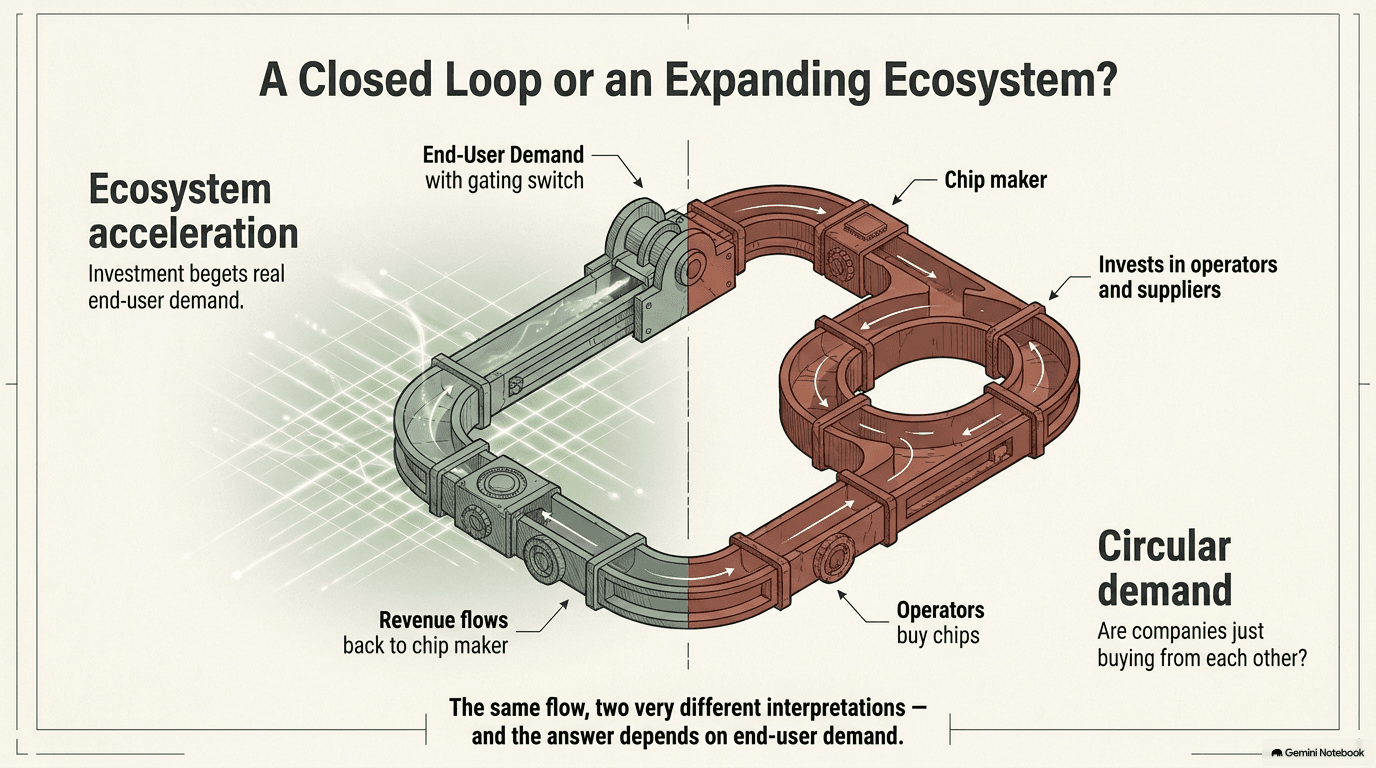
Both chains involve the same products flowing through the same companies. The difference is what sits at the end. Throughout this book, the same large chip maker appeared on multiple sides of deals — investing in the cloud operators that buy its chips and in the component suppliers that feed its systems. This creates a pattern that skeptics call circular: money flows from the chip maker to its customers as investment, and flows back from the customers to the chip maker as revenue when they buy GPUs. From a distance, it can look like a closed loop where the chip maker is, in effect, financing its own sales.
Supporters see this differently: they call it ecosystem-building. A dominant supplier helping its partners scale so the whole industry can grow — the way an anchor tenant in a shopping mall attracts other stores that benefit everyone. The chip maker's investments give startups and smaller operators the capital to build clusters they couldn't otherwise afford, which creates compute capacity that end users can rent, which drives genuine demand for the chips. In this view, the investments accelerate a virtuous cycle rather than creating an artificial one.
Both readings describe the same facts. The test that distinguishes them is deceptively simple: who is the end user? If you trace each dollar of GPU revenue back far enough, does it end at a real person or company doing something with AI that they're willing to pay for out of their own budget? Or does it end at another company in the same ecosystem, passing the dollar around in a loop?
Some of it clearly ends at real users. Enterprises are deploying AI for customer service, code generation, document analysis, and dozens of other tasks. Consumers are using AI assistants, image generators, and search tools. Governments and research institutions are running scientific simulations. This demand is real, growing, and in many cases generating measurable economic value.
But some of it is harder to trace. An AI startup buys GPU time from a NeoCloud. The NeoCloud buys the GPUs from the chip maker. The startup's revenue comes from venture capital, which is betting that the startup will eventually generate revenue from end users. How much of the total GPU demand today is backed by real end-user revenue, and how much is backed by venture capital's bet that the end-user revenue will eventually arrive? That question is genuinely difficult to answer from the outside, and the answer matters enormously — because it determines whether the capex of section 14.1 is an investment in essential infrastructure or an advance on demand that hasn't materialized.
There is a useful mental test for distinguishing the two readings. Pick any GPU cloud customer and ask: if this customer disappeared tomorrow, who would miss them — and would anyone's life be worse? If the answer is "end users who rely on the AI service this customer provides" — a hospital using AI diagnostics, a company whose software development depends on AI code assistance, a research lab running protein-folding simulations — then the demand is real. If the answer is "the GPU maker who loses a customer, and the cloud operator who loses a tenant, but no end user notices" — then the demand may be circular. The distinction is not always clean (many AI companies serve both real end users and other AI companies), but the test clarifies what to look for.
This book takes no side. It simply flags that the pattern is real, that serious, informed people disagree about what it means, and that the way to watch it is to track the growth of end-user revenue (not GPU shipments, not cloud bookings, but actual money from people and companies using AI services) relative to the growth of infrastructure spending.
Does the Math Work?
Here is the question everything comes down to. Hundreds of billions of dollars per year are being spent building the machine described in these fourteen chapters. For that to make sense, the AI services running on it must eventually earn enough — through subscriptions, cloud rentals, advertising, productivity, automation — to justify the cost, accounting for the fact that the GPUs themselves wear out and go obsolete every few years.
A brief detour on that last point, because it matters more than it might seem. An accountant would call it depreciation: spreading the cost of an expensive asset over its useful life. Every physical thing in this book has a lifespan, and those lifespans vary enormously:
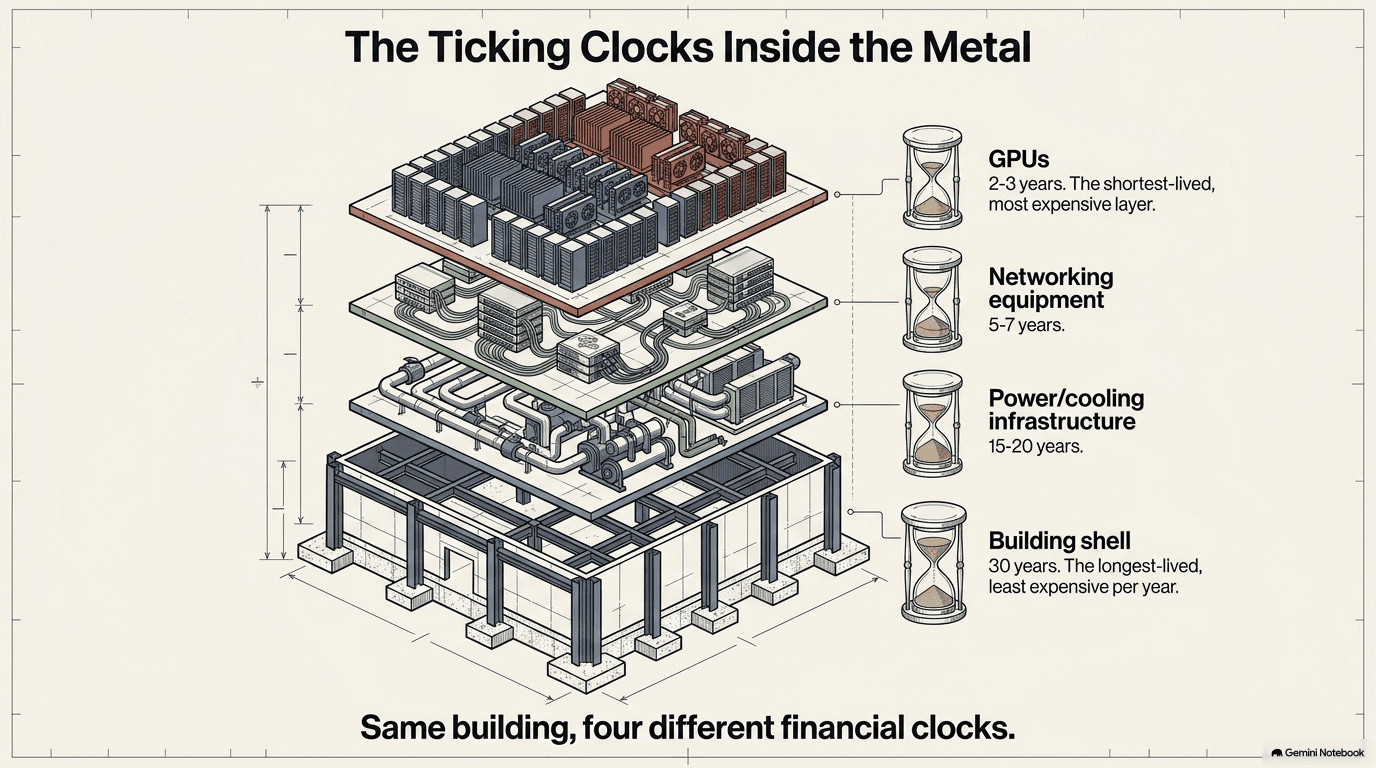
- A data-center building might last thirty years or more — the concrete, the steel, the electrical switchgear. Once built, it is an asset that earns rent for decades.
- The power infrastructure — transformers, switchgear, generators — lasts twenty to thirty years with maintenance.
- The cooling systems — chillers, pumps, piping — last fifteen to twenty years.
- The networking equipment — switches, transceivers — turns over every five to seven years as bandwidth demands grow.
- The GPU fleet turns over every two to three years as new generations arrive.
This creates a layered challenge. The operator must earn back the cost of the GPUs far faster than the cost of the building — and the faster the GPU cycle turns, the harder that math gets. A building is patient capital; a GPU is impatient capital. The building doesn't care if a better building design comes out next year — it still works, still earns rent, still depreciates slowly. The GPU does care: a newer generation that is twice as fast at the same price makes the old one worth half as much on the market, even if it still functions perfectly. This is the depreciation treadmill described in section 12.4, and it is the central economic tension of the operator business model.
This depreciation mismatch shapes how operators structure their finances. Broadly, the industry has developed several approaches to manage the tension between patient-capital buildings and impatient-capital GPUs.
Long-term lease structures separate the building from the hardware. The data-center owner (often a REIT, as described in section 14.2) holds the shell on a twenty-year depreciation schedule. The operator leases the shell and owns the GPU fleet separately, refreshing it every two to three years. This way, the building risk and the technology risk sit on different balance sheets with different return profiles.
As-a-service contracts push the depreciation problem upstream. Instead of buying GPUs outright, some operators lease them — or buy compute capacity from a cloud provider who owns the hardware. The operator trades lower margins for a shorter commitment: if a new GPU generation arrives, they can shift to it without writing off the old fleet. The cloud provider, in turn, manages the fleet refresh across thousands of customers, spreading the obsolescence risk.
Vertical integration is a third approach. The largest hyperscalers (the companies that both build the data centers and run the AI services) absorb all the layers internally. They buy the GPUs, build the buildings, generate or contract the power, and sell the AI service to end users. The depreciation risk doesn't disappear, but it is offset by the revenue the AI services generate directly. This only works at enormous scale — the hyperscaler needs enough end-user demand to keep the GPUs busy through their useful life.
Each structure distributes risk differently, but none eliminates it. The fundamental question — whether the AI services running on all this hardware generate enough revenue to justify the cost of building and refreshing it — runs through every layer of the financial stack.
That question touches everything in the previous thirteen chapters. The money is buying sand purified to eleven nines and printed with light; dies given bodies and married to stacked memory; racks wired into single machines with glass and light; warehouses cooled by rivers of liquid; power dragged down from the grid or generated on site; all of it made in a handful of irreplaceable factories, from materials pulled out of a few corners of the earth, run by hidden software, operated by a new class of company, and paced by the hard limits of time.
That is the buildout — and now, from the transistor to the money, you can see the whole of it.
This completes The AI Infra Buildout Encyclopedia — from the transistor to the money.
Companies in this part of the buildout: Services & Investment, Operators