Chapter 13
The Queue
The biggest limit on how fast AI infrastructure can grow isn't technology or even money — it's time, because the things you need take years to build and everyone in the world is ordering them at once.
A system chapter. It pulls together a thread that has run through the whole book: at nearly every layer, the constraint is not "can we make it?" but "how long until we can get it?"
The Four Bottlenecks
If you trace back what actually holds up an AI data center, you keep arriving at the same handful of long-lead-time items. Each one was introduced in an earlier chapter; seen together, they form a wall of waiting.
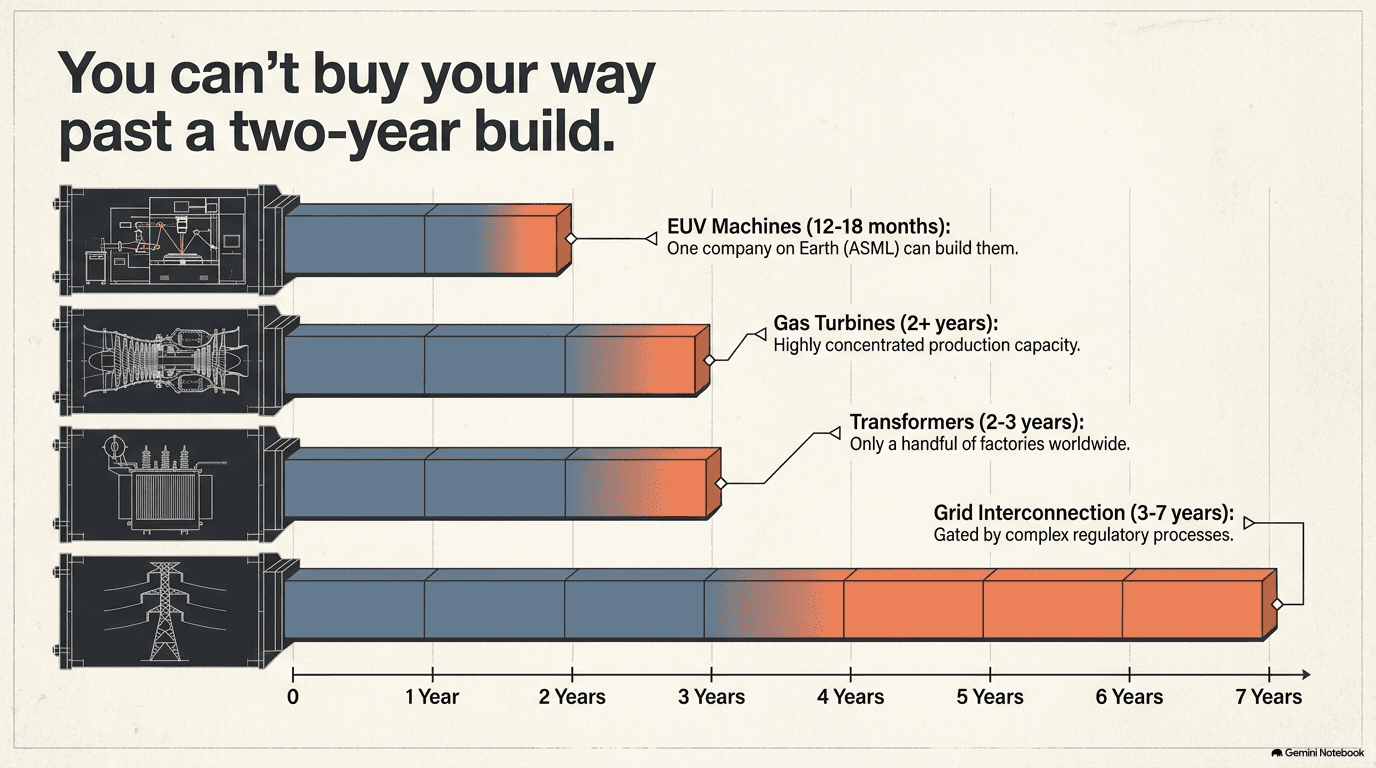
- Large power transformers (Chapters 6 and 9): lead times of two to three years and climbing, made in only a handful of factories worldwide. Consider what expanding transformer production actually requires: first, a company must design and build a new factory — a specialized facility with overhead cranes rated for hundreds of tons, winding machines, vacuum ovens for moisture removal, oil-purification systems, and high-voltage test bays. That alone takes three to four years. Then it must hire and train winding technicians, a skill that takes years to develop because transformer windings must be precisely layered and insulated by hand (there is no fully automated process for large units). Then it must secure a reliable supply of grain-oriented electrical steel, which is produced by even fewer mills than make transformers — the steel mills have their own expansion timelines, their own specialty equipment, and their own workforce constraints. The result is a bottleneck that cannot be accelerated by money alone: each layer of the supply chain has its own multi-year expansion path, and all must grow in parallel.
- EUV lithography machines (Chapters 1 and 9): only ASML (ASML) makes them, each takes roughly eighteen months from order to installation, each depends on mirrors from a single optics supplier (Carl Zeiss) that can polish only so many per year, and the total worldwide production is roughly sixty-five machines per year. That number cannot be meaningfully increased without expanding the mirror-polishing capacity, which requires building new cleanrooms and training new specialists — a process that itself takes years.
- Gas turbines and backup engines (Chapter 7): the turbine makers' backlogs extend two to three years into the future, and the reciprocating engines used for backup power (Chapter 6) carry lead times past two years. The turbine supply chain shares its specialty alloys and skilled workforce with the aerospace industry (Chapter 10), creating a cross-industry competition for the same constrained resources.
- Grid interconnection (Chapter 8): in many regions, simply getting approval to connect a large new load to the grid can take three to seven years — the study phase alone can consume three to five years, and the construction of any required grid upgrades follows after that.
Think about what these have in common. They are all heavy, precise, capital-intensive things made by very few companies, in facilities that themselves took years to build. They are not software; they cannot be scaled by adding a server or hiring a programmer. They are made of steel and copper and glass, by people with years of specialized training, in buildings that cost hundreds of millions of dollars to construct. When demand surges, the factory cannot respond overnight — it takes years to build a new factory, years to train the workers, years to qualify the products. In the meantime, everyone waits.
And the bottlenecks interact. A data center that can't get its transformer can't energize the building. A building with no power can't install and test the cooling. Cooling that can't run can't accept servers. Servers with no network are a collection of hot, expensive metal. And if the grid interconnection is denied, the entire project stalls — billions invested, permits expired, workforce dispersed. Each bottleneck doesn't just delay its own layer; it cascades forward through the entire construction sequence.
There is also a geographic dimension worth understanding. The bottlenecks are not evenly distributed around the world. The EUV machine queue is the same for everyone because there is only one factory. But the grid interconnection queue varies enormously by region — some US grid operators have relatively short queues, while others have backlogs stretching seven or more years. Transformer availability varies by voltage class and region. Labor availability depends on local construction activity. This means the buildout doesn't advance uniformly; it advances fastest in the places that happen to have the shortest queue across all four bottlenecks simultaneously — which is why site selection has become one of the most strategic decisions in the entire industry.
There is also a temporal coordination problem that is easy to overlook. A data center requires all four categories to be resolved at approximately the same time. It doesn't help to have the transformers delivered if the grid connection won't be ready for three more years. It doesn't help to have the grid connection if the servers can't be procured for eighteen months. The project manager must orchestrate dozens of parallel procurement and permitting workstreams so that everything converges at roughly the same moment — which requires placing orders and starting applications years before the facility is needed, based on demand forecasts that may change multiple times before the facility is built. Ordering too early ties up capital and risks obsolescence (the GPU generation you ordered might not be the one you want by the time the building is ready). Ordering too late means the facility sits empty while you wait for a component, burning cash on rent, power, and staff for a building that generates no revenue.
The most sophisticated operators manage this with detailed critical-path scheduling — project-management techniques originally developed for the aerospace and defense industries, applied to data-center construction. Every procurement item, every permit application, every construction milestone is mapped on a timeline, with dependencies between them explicitly tracked. The critical path — the longest chain of dependent activities — determines the project's minimum duration, and any delay on the critical path delays the entire project. In the current environment, the critical path almost always runs through either power infrastructure (transformers and grid connection) or GPU procurement, depending on which has the longer lead time for that specific project.
This is the fundamental tension of the AI buildout: the demand signal is digital (a CEO announces a new training cluster, and the order hits the supply chain in days) but the supply response is physical (the transformer to power it takes two years to build). That gap — between the speed of ambition and the speed of steel — is what this chapter is about.
Permitting and Approvals
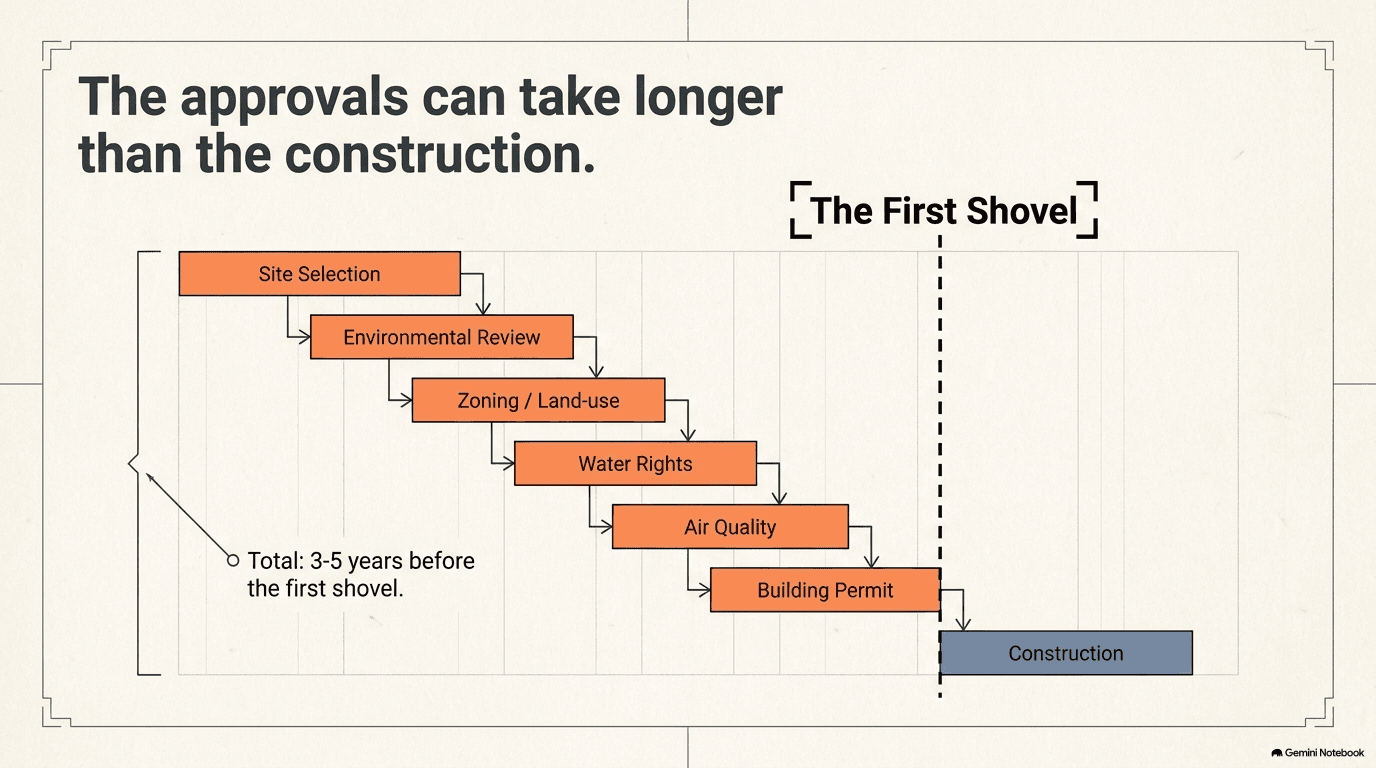
Even before construction begins, a data center must clear a thicket of approvals, and each one takes time.
Environmental review assesses the impact on the site's ecosystem — wetlands, endangered species, water runoff, air quality, noise, light pollution, and habitat disruption. For a project that will consume hundreds of megawatts and millions of gallons of water per day, running hundreds of diesel generators as backup, and operating twenty-four hours a day with exterior lighting and mechanical equipment noise, this review can be extensive. It may require environmental-impact statements, biological surveys, mitigation plans (such as creating new wetlands to offset those destroyed), and public comment periods that can stretch for months. In some jurisdictions, environmental reviews have been challenged in court by project opponents, adding years of litigation to the timeline.
Zoning and land-use approval determines whether a data center is allowed in that location at all. Many communities zone their land for residential, commercial, or light industrial use, and a data center — which is essentially a power-hungry warehouse with substantial outdoor mechanical equipment — may not fit neatly into any existing category. It generates more noise than an office building (cooling equipment runs twenty-four hours a day), more traffic than a warehouse (during construction and for periodic equipment deliveries), and more electrical load than virtually any other single-building use. Rezoning requires public hearings, planning-commission votes, and sometimes changes to a municipality's comprehensive plan — a process that can take six months to two years depending on the jurisdiction and the level of community opposition. Some developers have learned to pre-negotiate community benefit agreements — commitments to local hiring, road improvements, school funding, or infrastructure upgrades — as a way to reduce opposition, but these negotiations take time and add cost.
Water rights and discharge permits are increasingly significant, because a data center's cooling systems can consume millions of gallons of water per day (Chapter 5), and the water discharged back — warmer than it arrived, and potentially carrying treatment chemicals — can affect local waterways and ecosystems. In the western United States, water rights are governed by the "prior appropriation" doctrine ("first in time, first in right"), which means that newer users — like data centers — have junior rights that can be curtailed during drought before senior agricultural or municipal users are affected. Securing a reliable water right in these regions can take years of negotiation, often involving purchase of existing water rights from willing sellers (farmers, ranchers) or agreements with local water utilities for treated wastewater or recycled water. Some operators have responded by designing air-cooled or closed-loop cooling systems that consume no water at all (Chapter 5), trading higher energy costs for water independence.
Air-quality permits are required for any on-site generation — the gas turbines and diesel generators from Chapters 6 and 7 all produce emissions, and the permitting process for those emissions can add months or years to a project's timeline. The process typically involves modeling the dispersion of pollutants (nitrogen oxides, particulate matter, carbon monoxide) from the proposed generators to demonstrate that ambient air-quality standards will not be exceeded at any point in the surrounding area. For a campus with dozens of large diesel generators, this dispersion modeling alone can take months, and if the modeling shows that standards would be exceeded, the operator must either reduce the number of generators, install emissions-control equipment (selective catalytic reduction — a system that injects a chemical into the exhaust to convert nitrogen oxides into harmless nitrogen and water — or oxidation catalysts that burn off carbon monoxide and hydrocarbons), or find a different site. In regions that are already in "non-attainment" for certain pollutants — meaning the air quality already fails to meet federal standards — the permitting burden is heavier, and offsetting credits must be purchased before any new emissions source can be approved.
Community resistance is the human dimension, and it is worth understanding on its own terms rather than dismissing it as obstruction. A large data center changes a community in ways that are real and permanent. It draws enormous power — power that might otherwise have served homes and businesses, or that must be generated by new plants that bring their own emissions. It uses water, sometimes large quantities, in regions that may already be water-stressed. It generates noise — the continuous hum of cooling systems and generators can be audible for miles. It produces relatively few permanent jobs compared to the land and infrastructure it consumes (a facility that uses as much power as a small city might employ only a few dozen people once construction is complete). And it brings truck traffic during years of construction, followed by a largely invisible presence that contributes little to the local street life.
The benefits are also real: substantial property-tax revenue, construction jobs, and in some cases investment in local grid infrastructure that benefits everyone. But these benefits are often concentrated in the municipality's treasury while the costs are felt by individual residents — the homeowner whose property backs up against a humming mechanical plant, the farmer whose water allocation is reduced, the family whose utility rates increase because the grid operator must invest in new transmission capacity. Whether the tradeoff is worth it is a genuinely debatable question that reasonable people answer differently, and the growing pattern of community opposition reflects the fact that more communities are asking it.
Building permits themselves — the final layer before construction begins — involve their own review cycle. The structural engineering must be reviewed for seismic standards, wind loads, and fire safety. The electrical design must be reviewed for compliance with the National Electrical Code (or local equivalent). The mechanical systems must be reviewed for fire-suppression requirements, emergency ventilation, and exhaust treatment. Each review involves a separate department with its own queue of applications, and data-center designs are sufficiently unusual (few other buildings combine this much power density, this much cooling, and this many diesel generators in one location) that the reviewers may require additional time to evaluate unfamiliar configurations. Some jurisdictions have created dedicated fast-track permitting for data centers, recognizing their economic importance; others have not.
None of these steps is technically hard; all of them are slow, and they stack on top of the equipment lead times rather than overlapping neatly with them. You can order a transformer while waiting for the zoning approval, but you can't install it until the approval comes — and if the approval takes two years and the transformer takes two years, you need to order the transformer before you have permission to build, accepting the risk that the project might be denied.
Skilled Labor
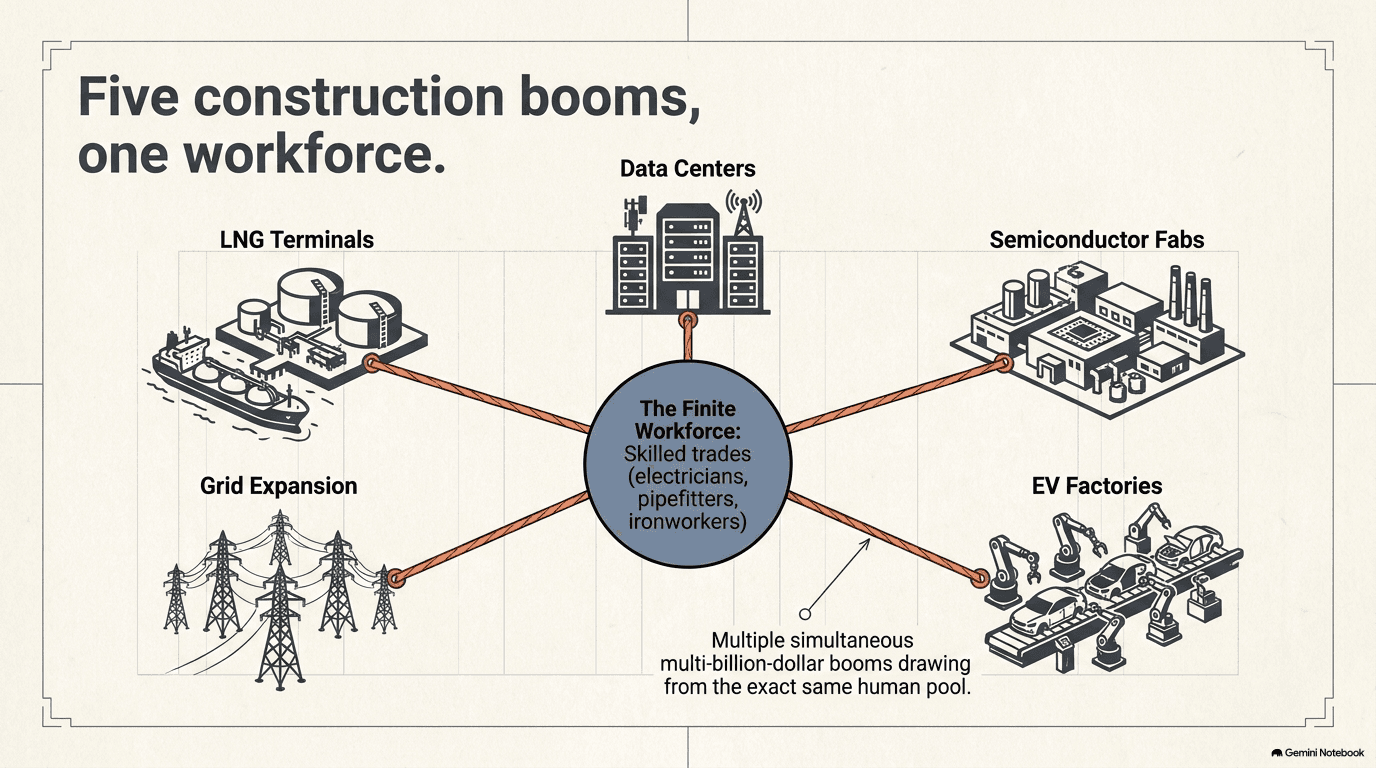
There is a bottleneck made not of steel but of people. Building and wiring a data center takes electricians, pipefitters, ironworkers, welders, sheet-metal workers, and commissioning engineers — and there aren't enough of them.
The scale of the labor demand is worth understanding concretely. A large data center project might employ a thousand or more construction workers at peak, with the electrical scope alone consuming hundreds of electricians for months. And these are not generic construction jobs.
An electrician working on medium-voltage switchgear (Chapter 6) needs to understand voltage classes, arc-flash hazards (the risk of an electrical explosion — a short circuit in high-voltage equipment can produce a flash of superheated plasma that reaches temperatures hotter than the surface of the sun, capable of causing severe burns and igniting clothing from several feet away), cable termination procedures, and the specific safety protocols for equipment that can deliver enough current to kill instantly. The certification path takes four to five years: typically a combination of classroom instruction, on-the-job apprenticeship, and state licensing exams. There are no shortcuts — you cannot compress a four-year apprenticeship into a bootcamp.
A pipefitter installing a liquid-cooling manifold (Chapter 5) needs to understand the metallurgy of the pipes and fittings, the specifications for each joint type (welded, brazed, threaded, press-fit), the pressure ratings, the leak-testing procedures, and the cleanliness requirements — because a metal shaving left inside a cooling loop will eventually reach a cold plate and block it. Pipefitters follow a similar four-to-five-year apprenticeship track.
A commissioning engineer who tests the entire electrical system under load needs to understand the interactions between the transformers, the switchgear, the UPS, the generators, and the IT load — and needs the experience to recognize when something doesn't sound right, doesn't smell right, or doesn't feel right, before the instruments confirm it. Commissioning a 100-megawatt electrical system is one of the highest-skill tasks in the construction industry.
An ironworker erects the structural steel. A sheet-metal worker builds the ductwork. A controls technician programs the building-automation system. A welder certifies each joint on the high-pressure piping. Each is a distinct trade with its own training pipeline, its own union, and its own constraints on how fast the workforce can grow.
The problem is not that these skills are rare in absolute terms — the building trades in the United States employ millions of people — but that the same skilled trades are needed simultaneously by every other construction boom happening at once. Semiconductor fabs (Chapter 9), LNG export terminals, electric-vehicle battery factories, solar and wind farms, grid modernization projects, and highway construction are all competing for the same workforce. The data-center builders — construction and engineering companies like EMCOR (EME), Comfort Systems (FIX), Dycom (DY), and MYR Group (MYRG) — have more work available than they can staff. Growth is limited less by the demand for their services than by how fast they can hire and train.
Apprenticeship programs take three to five years. A typical electrical apprenticeship involves 576 hours of classroom instruction plus 8,000 hours of on-the-job training under a journeyman — roughly four years of full-time work before a person can work independently. There are no shortcuts: the work involves voltages that kill, and the only way to learn judgment about electrical hazards is time spent around them under supervision.
Experienced workers can be recruited from other trades or from other regions, but not without bidding up wages (which feeds into the cost of the buildout) and pulling capacity away from other sectors (which slows their projects). Data-center construction now competes for labor with semiconductor fabs (Chapter 9 — which also need electricians and pipefitters), electric-vehicle battery plants, solar and wind farms, LNG terminals, grid modernization, and highway projects. Each of these is running its own construction boom, and the total demand for skilled trades exceeds the total supply by a meaningful margin.
This is a classic example of a constraint that cannot be solved by spending more money — you cannot train an electrician faster by paying more; you can only train more of them, and that takes years. Some companies are investing directly in training: building their own apprenticeship programs, partnering with community colleges, and offering scholarships. But even these initiatives take years to produce journeymen, and the gap between the demand growth rate and the training throughput is widening, not narrowing.
The response to the labor shortage has taken several forms, none of them complete. Modular and prefabricated construction (Chapter 4) reduces the amount of on-site skilled labor by moving work to a factory, where the conditions are more controlled, the workers can specialize more narrowly, and the output is more consistent. A power module that arrives pre-wired and pre-tested needs fewer electricians to install than the same equipment built from components on site. But prefab doesn't eliminate the need for skilled trades — it shifts some of the work to factory settings and reduces the peak on-site headcount. Automation in construction is advancing slowly — robotic welding, automated cable routing, drone-based inspection — but construction remains one of the least automated industries, and the site conditions (every building is different, every site has unique constraints) resist the standardization that automation requires. Immigration of skilled tradespeople from other countries has historically been a safety valve for construction labor shortages, but it depends on visa policies and is unevenly available across regions.
The most sobering aspect of the labor constraint is its interaction with the other bottlenecks. A delayed transformer means the electricians hired for commissioning must wait — and if they're released to work on other projects during the delay, they may not be available when the transformer finally arrives. A permitting delay that shifts a construction start by six months means the project competes with a different set of other projects for the same labor pool, and the pricing may be entirely different. The labor market doesn't wait for any individual project; it flows toward whoever is ready to build, and a project that misses its window may find itself at the back of a new queue.
The Interconnection Queue
The single most telling constraint is the grid interconnection queue, and it deserves its own section because it is both the most important bottleneck and the most difficult to solve.
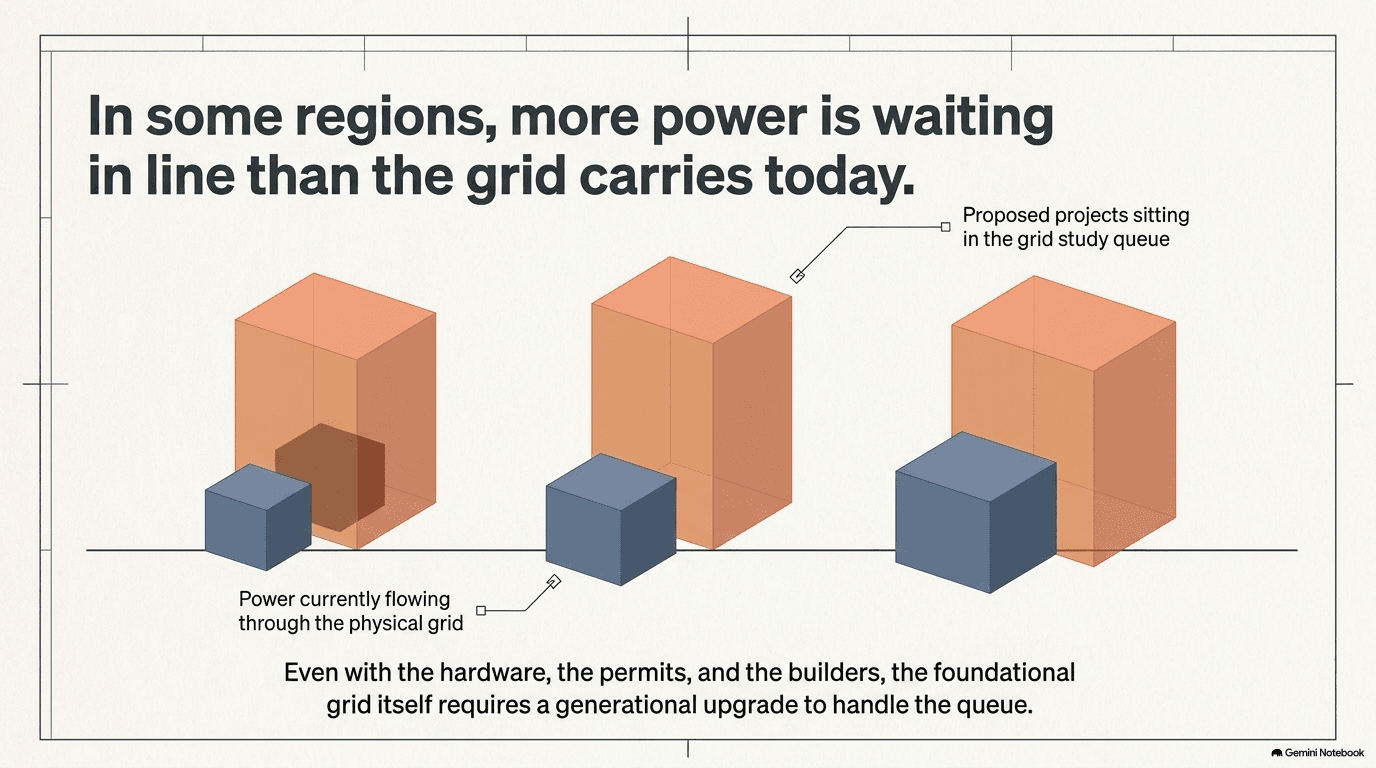
In several US regions, the total capacity of power projects waiting in line to connect to the grid now exceeds the grid's entire current capacity — more electricity is queued up to come online than the system presently carries. This is an extraordinary fact. It means that even if every queued project were built tomorrow, there wouldn't be enough grid infrastructure (transmission lines, substations, transformers) to connect them all. The queue includes not just data centers but solar farms, wind farms, battery-storage projects, and industrial loads — all competing for the same limited grid-connection capacity.
The queue exists because connecting a large new source or load to the grid requires a series of engineering studies, and each one is genuinely necessary. Feasibility studies assess whether the grid can physically handle the new load without overloading any existing equipment. System-impact studies model how the new load affects voltage stability (whether the voltage stays within safe limits), frequency response (whether the grid can maintain its 60-cycle-per-second rhythm under the new load), and power flows across a wide area — because electricity doesn't obey property lines; a large new load in one county can stress transmission lines three counties away. Facility studies determine what specific upgrades (new transmission lines, bigger transformers, upgraded substations) are needed and how much they'll cost. The applicant typically pays for the upgrades, which can run into the tens or hundreds of millions of dollars.
These studies are conducted by the regional grid operators — the organizations that manage the high-voltage transmission system — who are typically understaffed, working through a backlog of applications that has grown faster than their engineering teams, and required to study projects in the order they were proposed. The result is a first-come, first-served queue that can take three to five years just to get through the study phase — before any construction begins. Making matters worse, a large fraction of the projects in the queue are speculative (they were submitted to hold a place in line and may never be built), which congests the queue further and forces the grid operator to study projects that will never materialize, delaying the real ones behind them.
Some operators are attempting to bypass the queue entirely by building their own generation on site — "behind the meter" (Chapter 7) — which doesn't require a grid interconnection study because no new load is being added to the public grid. This is a large part of why the on-site-power trend described in that chapter exists: it is not just about reliability or cost, but about speed. A gas turbine that can be installed behind the meter in eighteen months is years ahead of a grid connection that takes five years to permit.
Others are finding creative paths. Some acquire sites with existing high-power connections — retired factories, aluminum smelters (Chapter 10), steel mills, or decommissioned power plants whose grid connections are already built and permitted. These "brownfield" sites trade the cost and delay of new grid interconnection for the cost of site remediation and renovation, and in the current environment the trade is often favorable. Others locate next to existing generation sources — a nuclear plant, a gas-fired power station — where the power can flow directly without traversing congested transmission lines. A few are even exploring co-location with new nuclear plants, betting that small modular reactors (Chapter 7) will provide dedicated power that bypasses the grid entirely.
The interconnection queue creates a secondary effect that is worth noting: it inflates the value of permitted power far beyond what the physical assets themselves are worth. A site with a 500-megawatt grid interconnection that is already permitted and built may be worth more than the sum of its buildings and equipment, simply because replicating that interconnection from scratch would take five or more years. This is the fundamental economic logic behind the crypto-pivot story in Chapter 12 — those companies' most valuable asset is not their mining rigs or their buildings; it is their permitted electrical capacity.
What is being done about the queue. The gridlock is not going unnoticed. Grid operators in the United States have begun implementing reforms: some have introduced "cluster study" processes that evaluate groups of projects in a region together (rather than one at a time), which can identify shared grid upgrades that benefit multiple projects and avoid the wasted study effort of projects that are only speculative. Others have introduced "readiness milestones" — financial deposits and development-progress requirements that weed out speculative applications early, clearing the queue for serious projects. Some states have created expedited permitting pathways for projects deemed economically significant.
On the industry side, the responses include everything described in earlier chapters: on-site generation (Chapter 7) to bypass the grid entirely, modular construction (Chapter 4) to reduce site-preparation time, prefabricated power systems (Chapter 6) that arrive pre-tested, and the crypto-pivot model (Chapter 12) that repurposes existing permitted sites. Some operators have even considered co-locating with existing power plants — nuclear, gas, or even retiring coal plants — where the grid connection is already built and sized for large loads.
But none of these workarounds eliminates the underlying constraint. They reroute around it, find shortcuts through it, or nibble at its edges — and in doing so they add cost, complexity, and risk. The cleanest solution — building more grid capacity to match the demand — is itself a multi-year, multi-billion-dollar construction project that faces its own permitting, labor, and materials bottlenecks. Transmission lines are among the hardest infrastructure projects to build, because they cross multiple jurisdictions, each with its own permitting authority, and they must secure easements from every property owner along the route. A new high-voltage transmission line from a power plant to a data-center campus can take seven to ten years from proposal to energization.
The interconnection queue is the clearest single picture of the whole problem this chapter describes. The demand is here now, and the physical world — the grid, the factories, the workforce, the permitting process — simply cannot be rebuilt as fast as the models can be trained. This is the sober counterweight to the entire book. Everything in Chapters 1 through 12 is real and being built at enormous scale — but it is being built into a set of hard physical limits, and those limits, more than any shortage of ambition or capital, will pace how fast the AI buildout can actually happen.