Chapter 10
The Materials
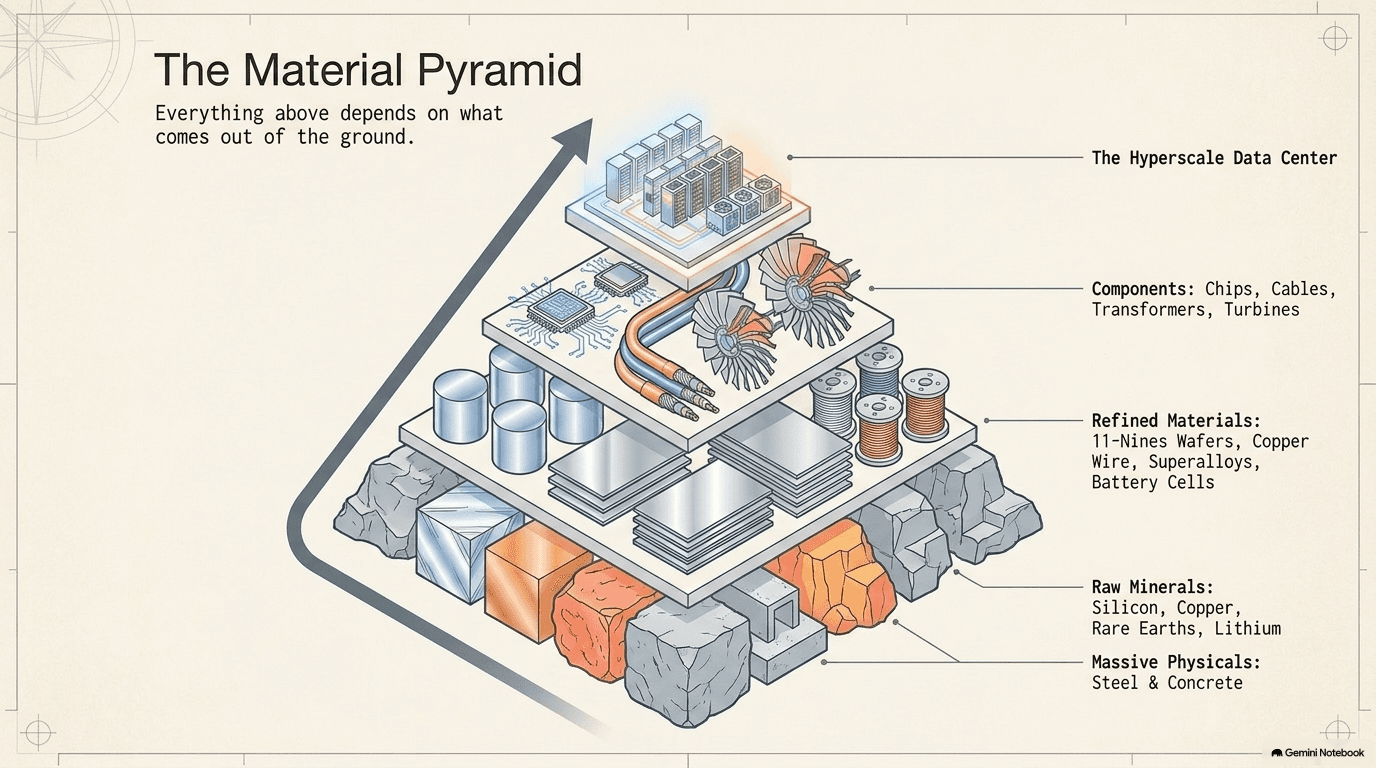
Everything in a data center — from the chip to the concrete foundation — begins as raw material dug out of the ground, and some of those materials are rarer, more geographically concentrated, and harder to replace than most people realize.
One of the quietest facts about the AI buildout is that it is, at bottom, a mining story. The "cloud" is made of sand, copper, steel, and stone, plus a handful of exotic elements without which the most advanced components simply cannot exist. This chapter traces that material foundation.
From the Ground Up
If you tried to trace every material in a modern AI data center back to its source, you would end up at mines, quarries, oil wells, and chemical plants on every continent. The chip started as sand (Chapter 1). The copper wiring started as ore, dug from open pits in Chile or tunneled out of mountains in Peru. The transformer's core is steel with a particular crystal structure, rolled in specialty mills. The concrete foundation is crushed aggregate, cement, and water. The cooling pipes are copper or stainless steel. The fiber is ultra-pure glass drawn from a preform (Chapter 9).
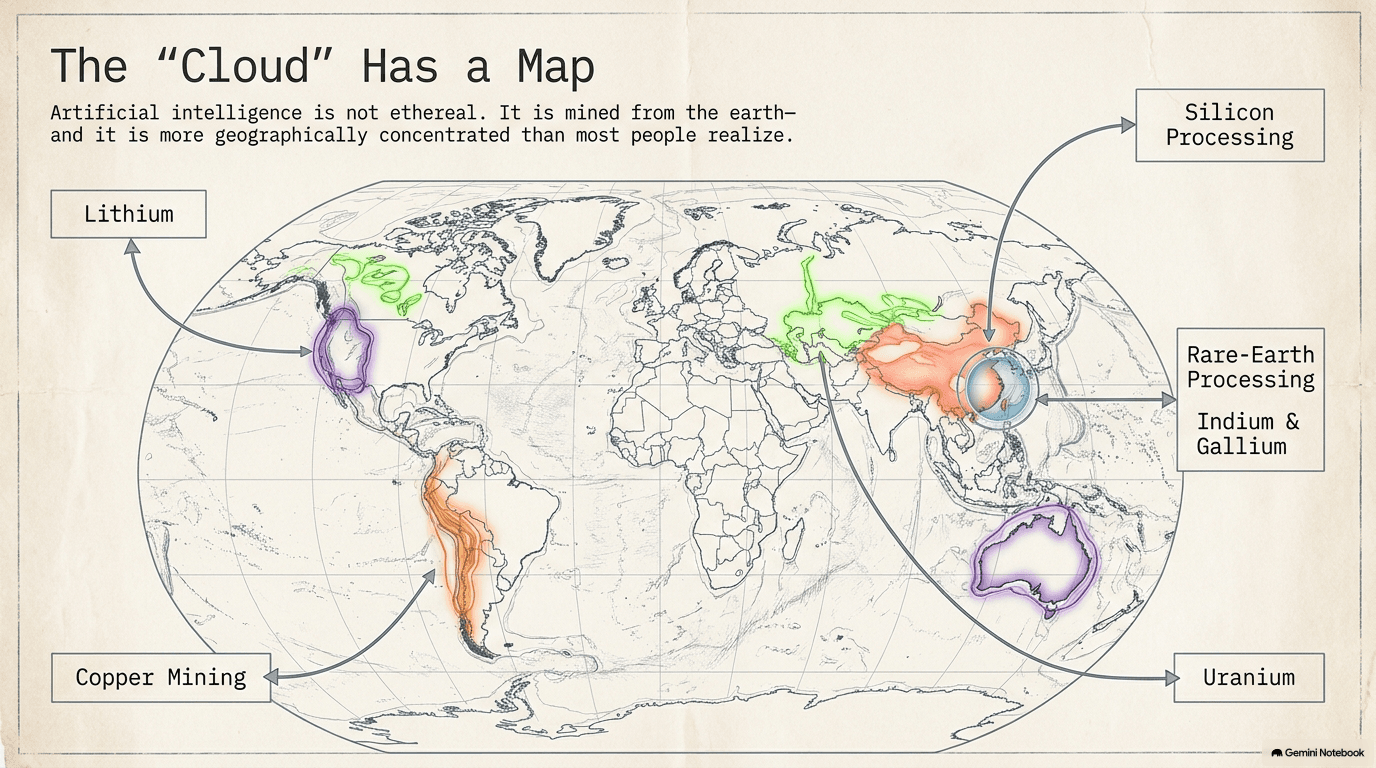
What makes this interesting, and occasionally alarming, is that the supply chains for these materials are far more concentrated than most people expect. The world's most advanced chips are made on an island by one company (Chapter 9) — but the materials those chips are made from have their own concentrations: a single country dominates rare-earth processing, a handful of mines produce the majority of the world's copper, and certain exotic elements that are essential for specific components come from just one or two countries. These concentrations don't usually make headlines, because the materials are unglamorous, but they represent some of the deepest vulnerabilities in the entire buildout.
This chapter works through the major materials, from the most fundamental to the most exotic, explaining what each one does, why it's hard to replace, and where it comes from.
Silicon — the Foundation
We start where the chip started, in Chapter 1: silicon. It is the second most abundant element in the Earth's crust — ordinary sand is mostly silicon dioxide — so the raw material is, in a sense, everywhere. The challenge, as Chapter 1 described, is what happens between sand and chip.
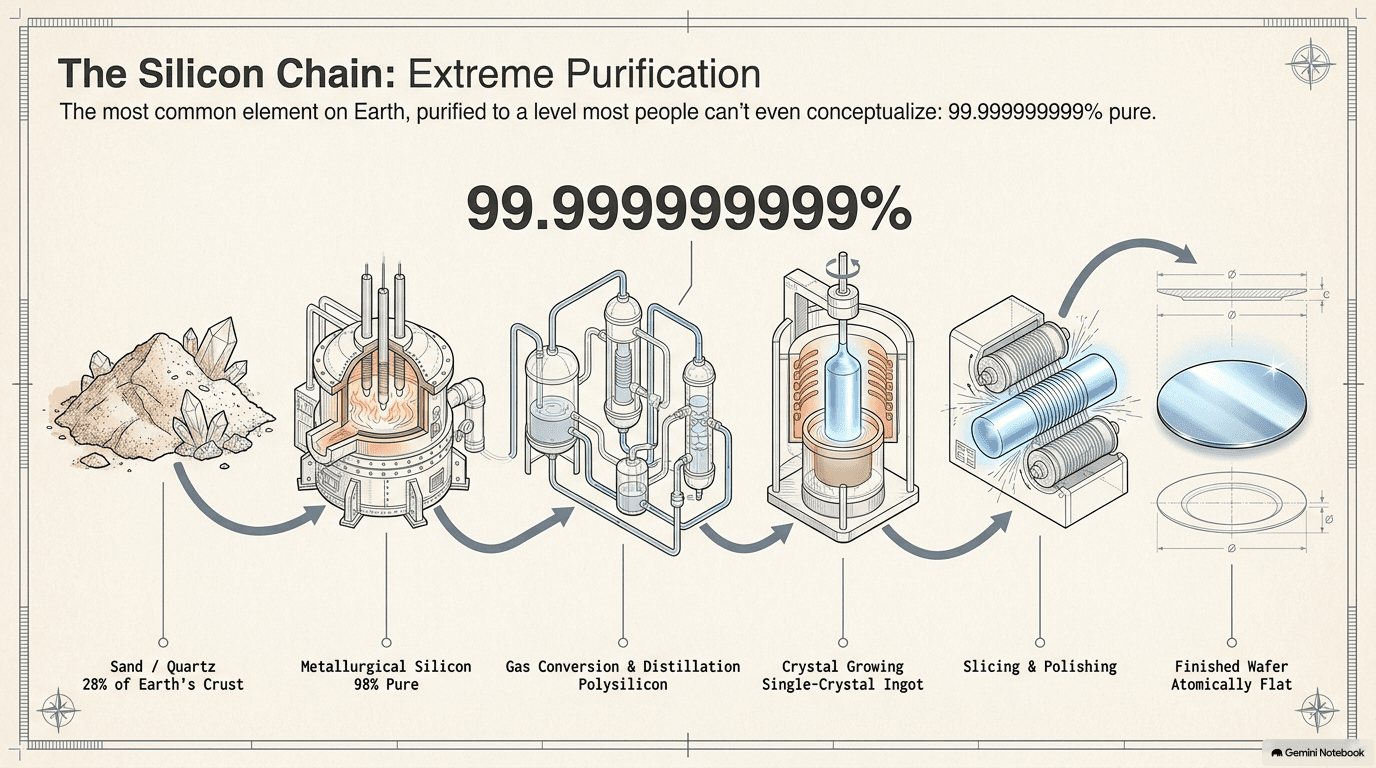
Metallurgical-grade silicon is made by heating quartz (high-purity sand) with carbon in an electric arc furnace at around 2,000°C, driving off the oxygen and leaving silicon metal — about 98-99% pure. This is already a specialized product, made by a small number of producers including Ferroglobe (GSM), and it is the feedstock for two important downstream industries: semiconductor wafers and aluminum alloys (silicon is added to aluminum to improve its casting properties, which matters for the server chassis and heat sinks from Chapter 2).
Polysilicon is the next step: the metallurgical silicon is converted to a gas (trichlorosilane), purified through fractional distillation — a process that exploits the fact that different impurities boil at slightly different temperatures, allowing them to be separated — and deposited back as solid silicon of extraordinary purity — "eleven nines," or 99.999999999%. To put that in perspective: if you had a swimming pool full of this silicon, the total impurity would be about a thimbleful. The reason purity matters so enormously is that even a few atoms of the wrong element in the wrong place can change the electrical properties of the chip in unpredictable ways — the transistors are built by deliberately introducing specific impurities (dopants) in precise locations, and background contamination would scramble that precision.
This poly is then melted and slowly pulled into a perfect single crystal using the Czochralski process, named after the Polish chemist who invented it in 1916: a seed crystal — a small piece of silicon with the desired crystal orientation — is dipped into a crucible of molten silicon at over 1,400°C and slowly drawn upward while rotating. The liquid solidifies onto the seed in a single unbroken crystal lattice, atom by atom, each one finding its place in the three-dimensional grid. The pulling speed is typically only a few centimeters per hour — pull too fast and the crystal develops defects; too slow and you waste furnace time. The crucible itself is made of quartz, and it slowly dissolves into the melt (introducing trace oxygen), so the process must be carefully controlled to keep the oxygen below levels that would affect the chips. Growing a single ingot can take days.
The crystal ingot — typically about 30 centimeters in diameter and a meter or more long — is then sliced with diamond-wire saws (a continuous loop of wire embedded with industrial diamonds) into thin wafers, each about three-quarters of a millimeter thick. The slicing wastes nearly half the crystal as sawdust (called kerf loss), which is why the industry is continually pushing for thinner wires and alternative cutting methods. Each wafer is then lapped, etched, and polished to atomic flatness — the surface must be so smooth that the lithography systems in Chapter 1 can print features measured in nanometers without the light scattering off surface imperfections.
Silicon itself is not a bottleneck today — the raw material is abundant, and the wafer-manufacturing capacity, while concentrated in a few countries (Japan, South Korea, Germany, Taiwan), is well-established. But it is a useful reminder that even the most common starting material requires an extraordinary chain of purification and precision before it can become a chip. The gap between "sand" and "eleven-nines single crystal" is one of the widest in all of industrial chemistry, and every wafer that enters a fab carries with it the accumulated effort of that entire chain.
Copper — the Universal Conductor
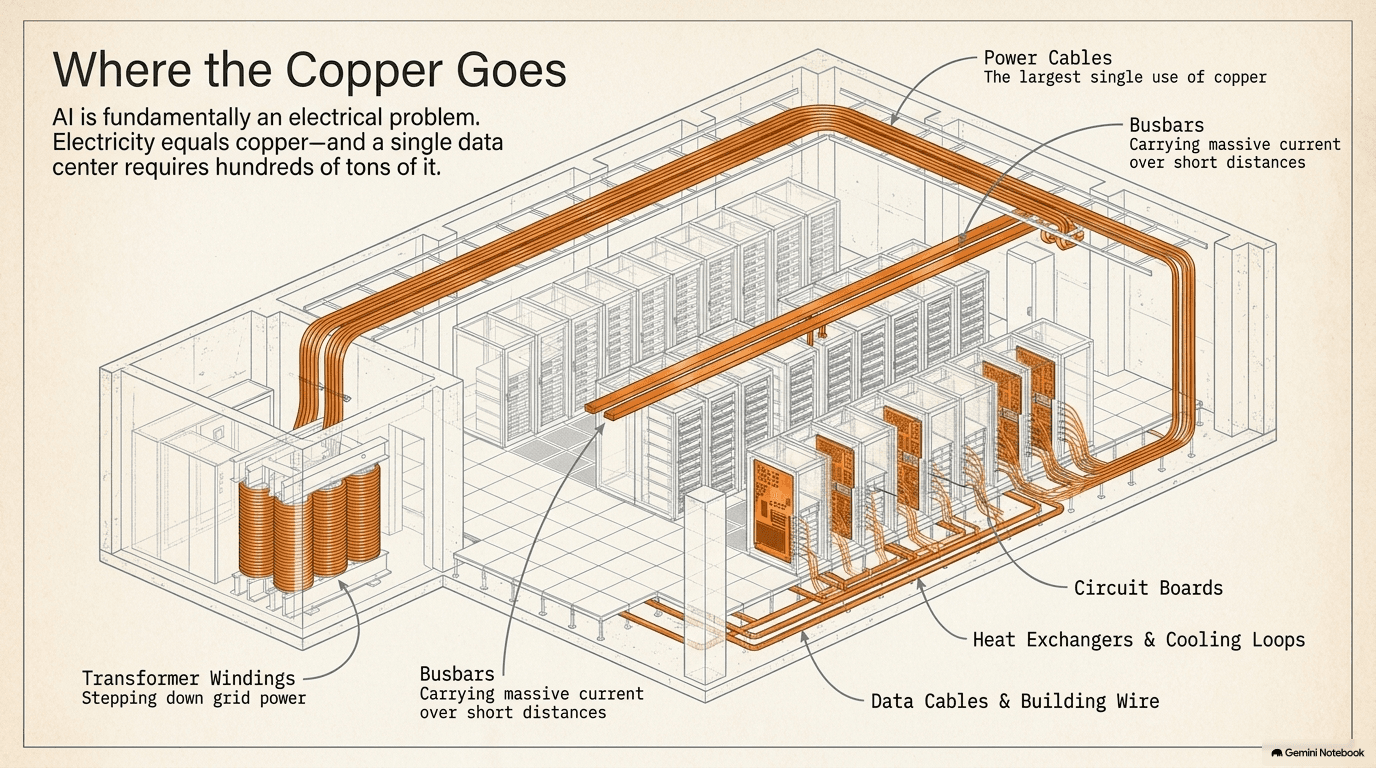
If silicon is the brain of the buildout, copper is the bloodstream. It is in the power cables, the transformer windings, the circuit boards, the heat exchangers, the building wire, the data cables, and dozens of other components. A single large data center uses millions of pounds of it. The phrase has been put simply by the mining industry itself: "electricity equals copper."
Copper begins as ore, dug from open-pit or underground mines — the largest are in Chile, Peru, the Democratic Republic of Congo, and Indonesia. The ore typically contains only about 0.5-1% copper by weight; the rest is rock. To grasp that ratio: to get one ton of copper, you must move and process one to two hundred tons of rock. This is why copper mines are among the largest human-made excavations on the planet — some open pits are several kilometers across and a kilometer deep.
The ore goes through a multi-stage process. First it is crushed and ground — massive jaw crushers break the rock into fist-sized pieces, then ball mills (rotating cylinders filled with heavy steel balls) grind it to a fine powder, as fine as flour. Then comes froth flotation: the powder is mixed with water and small quantities of chemicals that selectively attach to the copper-bearing mineral particles, making them hydrophobic. Air is bubbled through the mixture, and the coated copper particles cling to the bubbles and rise to the surface as a froth, which is skimmed off. This elegant separation — exploiting the fact that you can make copper minerals prefer air bubbles over water — concentrates the copper from 1% to about 30%.
The concentrate is then smelted: heated in a furnace to over 1,200°C, where the copper separates from the sulfur and iron. The molten copper is cast into large slabs called anodes. These anodes go into the final stage, electrolytic refining: they are suspended in a tank of copper sulfate solution alongside thin sheets of pure copper (cathodes), and electric current is passed through the solution. Copper dissolves from the impure anodes and plates onto the cathodes, atom by atom, leaving the impurities behind as a mud at the bottom of the tank. The result is copper cathode of 99.99% purity — the same electrical-grade copper that goes into everything from transformer windings to circuit board traces. The entire chain — from blasting rock to shipping refined copper cathode — takes weeks and consumes substantial energy at every stage.
From the refinery, copper cathode goes to wire mills, where it is heated and drawn through progressively smaller dies to produce wire of various gauges. The drawing process is itself precise: each pass through a die reduces the diameter slightly, and the wire must be annealed (softened by heating) between passes to prevent it from becoming brittle. A single large data center uses millions of pounds of finished copper wire and cable. This wire becomes everything from the hair-thin traces inside a circuit board to the thumb-thick cables that carry megawatts from a transformer to a building. The major copper miners — Freeport-McMoRan (FCX), BHP (BHP), Rio Tinto (RIO), Southern Copper (SCCO), Teck Resources (TECK) — all see data centers as a significant and growing source of demand.
The structural concern about copper is not that it's rare — it isn't — but that new mines are extraordinarily difficult to develop. A large copper mine takes ten to fifteen years from discovery to first production, requires billions of dollars of investment, and must navigate environmental reviews, community relations, water rights, and often unstable political environments. The permitting process alone for a new mine can take five to seven years in jurisdictions with rigorous environmental review — and unlike a data center, which occupies a few dozen acres, a large open-pit copper mine disturbs thousands of acres, generates enormous volumes of waste rock and tailings, and permanently alters the landscape. Some proposed mines have been delayed or blocked entirely by community opposition or environmental concerns, regardless of the economic value of the copper they would produce.
Meanwhile, existing mines are gradually declining in ore grade — the copper concentration in the ore being mined today is lower than it was decades ago, which means more rock must be processed to produce the same amount of copper, increasing both costs and energy consumption. The richest, easiest deposits have mostly been found and developed; new discoveries tend to be deeper, more remote, lower grade, or in jurisdictions with higher political risk.
Demand is rising from multiple directions at once: data centers, electric vehicles (which use two to four times as much copper as internal-combustion vehicles), grid modernization, renewable energy (solar farms and wind turbines are copper-intensive), and the general electrification trend across transportation, heating, and industry. The mining industry widely projects a structural copper deficit — demand growing faster than supply — over the coming decade. This won't halt the buildout, but it will keep copper prices elevated and add to the cost of every component that uses it — from the transformer windings of Chapter 6 to the building wire of Chapter 4 to the circuit boards of Chapter 1.
Compound Semiconductors — the Exotic Wafers
Silicon is the default material for chips, but several critical components in the AI buildout require something more exotic. These compound semiconductors — made by combining two or more elements — have physical properties that silicon cannot match, and their supply chains carry their own concentrations and vulnerabilities.
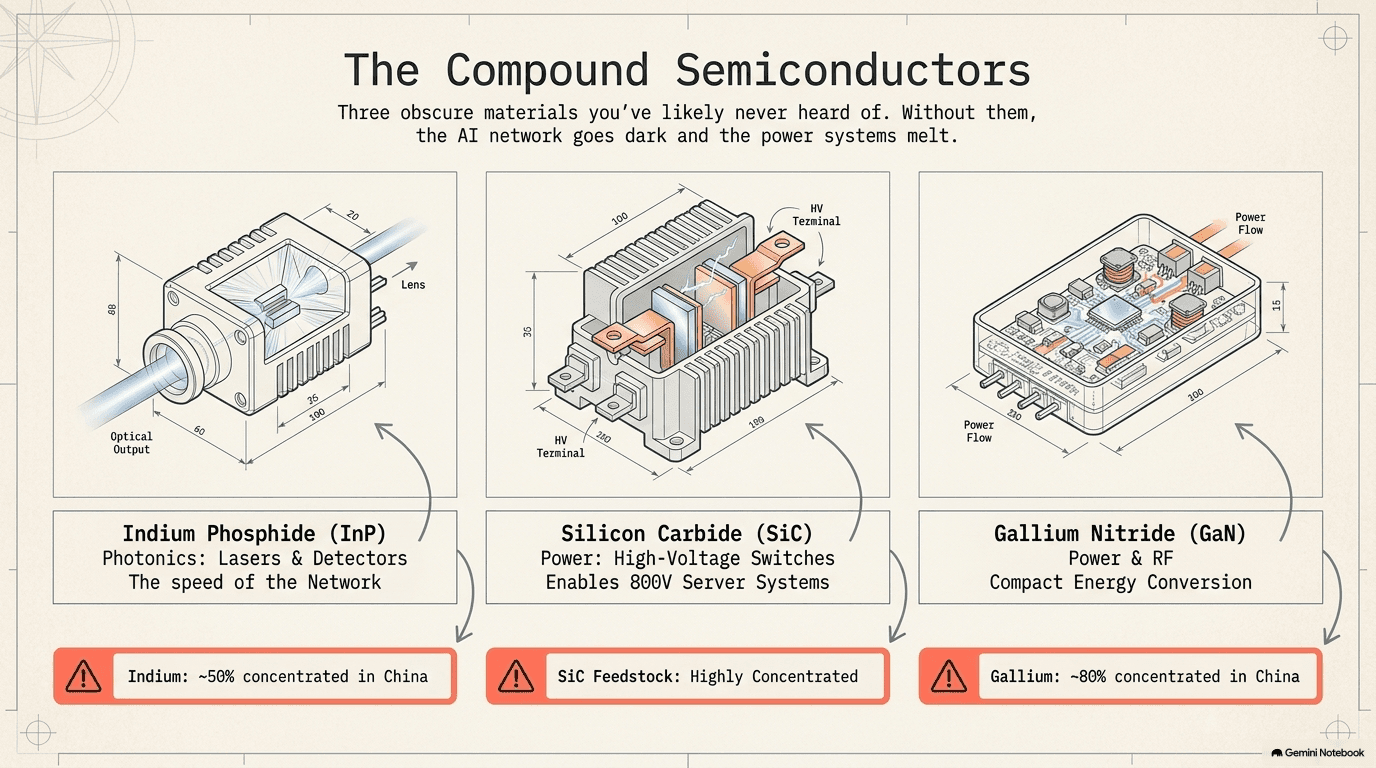
Indium phosphide (InP) is the material for the lasers inside optical transceivers (Chapter 3). Every beam of light carrying data between GPUs, between racks, between buildings, originates in a tiny laser diode made on an InP wafer. The reason is physics: InP has a direct bandgap that allows it to emit light efficiently at the wavelengths that travel best through optical fiber (around 1,310 and 1,550 nanometers). Silicon has an indirect bandgap — it can detect light, but it cannot emit it efficiently, which is why every attempt to build a silicon laser has been either impractical or inefficient. For the foreseeable future, optical communication requires InP.
Making an InP wafer is far harder than making a silicon wafer. The crystal growth uses a different technique called the vertical gradient freeze (VGF) method: a crucible containing a melt of indium and phosphorus (the phosphorus is maintained under high pressure because it evaporates readily) is slowly cooled from the bottom up, and a crystal solidifies upward from a seed at the base. The process is inherently more temperamental than silicon's Czochralski method — the two-element melt is harder to control than pure silicon, the crystal is more prone to defects, and the resulting boule (the cylindrical crystal ingot that will be sliced into wafers) is smaller (typically 100mm or 150mm diameter, compared to silicon's 300mm). The wafers are also more fragile — InP is brittle and cracks more easily during handling — and the yields of devices made on InP wafers are lower than those on silicon.
AXT (AXTI) is a leading maker of InP wafers, and its story is inseparable from geography — all of its manufacturing is in China, and selling those wafers to the United States requires export permits from the Chinese government. This makes InP wafers a geopolitical chokepoint beneath the more visible ones: if China were to restrict InP wafer exports, the entire optical-transceiver industry — and therefore the networking layer of every AI data center (Chapter 3) — would feel the impact.
Silicon carbide (SiC) is the material for the high-voltage power semiconductors in the 800-volt DC distribution systems described in Chapter 6. Silicon carbide can handle higher voltages, higher temperatures, and switch faster than ordinary silicon, which makes it ideal for the power-conversion stages where efficiency matters most — a few percentage points of switching efficiency, multiplied across a 100-megawatt facility, translate into megawatts saved.
Making SiC wafers is extremely difficult, and the difficulty is fundamental to the material's crystal structure. The crystal is grown by a process called physical vapor transport: SiC powder is heated to over 2,200°C in a graphite crucible, sublimating it (turning it directly from solid to gas without passing through liquid), and the gas condenses onto a cooler seed crystal above. The growth rate is painfully slow — a few hundred microns per hour — and a single boule (the cylindrical crystal ingot) can take a week to grow. During that week, the temperature, pressure, and gas composition must be held precisely steady; any variation introduces crystal defects that ruin the wafer's electrical properties. And because SiC is one of the hardest materials known (9.5 on the Mohs scale, compared to diamond's 10), cutting the boule into wafers and polishing them requires diamond abrasives and takes far longer than the equivalent steps for silicon. A SiC wafer costs roughly ten times what a silicon wafer of the same size costs, and the wafers are smaller (typically 150mm diameter, versus 300mm for silicon), which means fewer chips per wafer.
Wolfspeed (WOLF) is a vertically integrated SiC maker — mining, crystal growth, wafer fabrication, and device manufacturing under one roof — competing with onsemi (ON) from Chapter 2. The supply of SiC wafers is a bottleneck for the entire power-electronics industry, and the difficulty of scaling crystal growth is the reason: you cannot simply build a bigger furnace and grow bigger crystals; the physics of the sublimation process imposes its own pace.
Gallium nitride (GaN) is a newer entrant, used for compact, high-efficiency power converters and increasingly for RF components. GaN operates on a different manufacturing principle than SiC: instead of growing a bulk crystal and slicing it into wafers, GaN is typically deposited as a very thin layer (measured in microns) on top of a silicon or SiC substrate using a technique called metalorganic chemical vapor deposition (MOCVD). In MOCVD, organometallic gases containing gallium and nitrogen are flowed over a heated substrate, and the atoms arrange themselves on the surface one layer at a time. The process is sensitive to gas flow, temperature uniformity, and substrate quality — and the challenge of growing a crystal with one lattice constant on a substrate with a different lattice constant (called "lattice mismatch") introduces strain and defects that must be carefully managed.
Because GaN is grown as a thin film rather than a bulk crystal, it is somewhat easier to scale than SiC (you can use larger substrates and standard MOCVD reactors), which is why GaN power devices are increasingly competitive with SiC for certain applications — particularly in the lower-voltage, lower-power converters used in server power supplies and phone chargers. But the gallium supply is still concentrated.
The raw materials themselves introduce a deeper geopolitical dimension: China produces an estimated half of the world's indium and the large majority of its gallium, and has at times restricted their export. This is a quiet chokepoint beneath the more visible ones — if the raw elements are hard to obtain, the exotic wafers are hard to make, and without the wafers the lasers and power switches that the data center depends on cannot be manufactured.
Magnets, Alloys, and Energy Metals
A set of materials that don't go into the data center's compute equipment but are essential to the power and industrial systems around it.
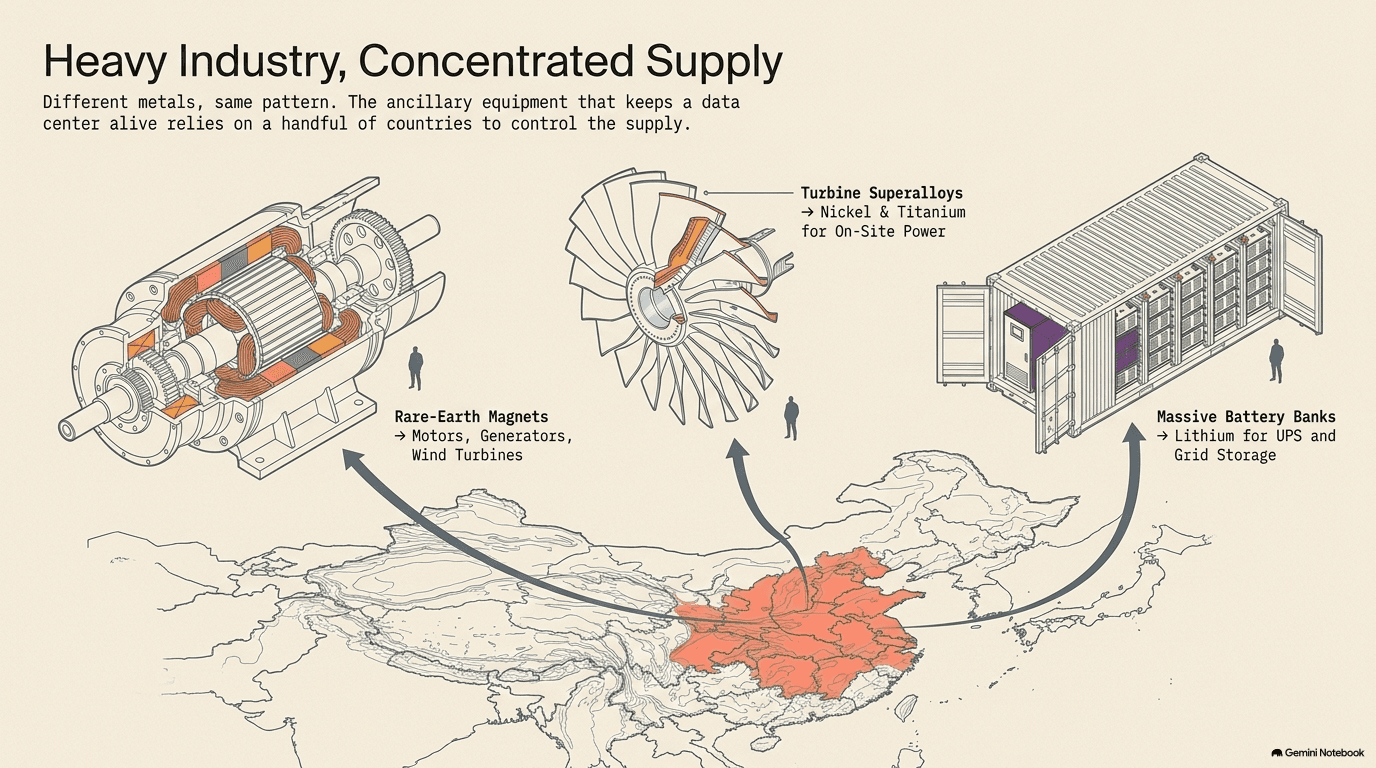
Rare earth elements are used to make the powerful permanent magnets inside motors, generators, and wind turbines. Despite the name, they are not geologically rare — cerium, the most common rare earth, is more abundant than copper in the Earth's crust. The difficulty is in the processing, not the geology.
The ore itself is often mixed with radioactive thorium, which means mining produces low-level radioactive waste that requires careful handling and disposal — a significant environmental and regulatory burden. But the real bottleneck is separation. Rare-earth ores contain a dozen or more different rare-earth elements jumbled together, and these elements are so chemically similar to each other that separating them is extraordinarily tedious. The standard technique is solvent extraction: the ore is dissolved in acid, and the solution is passed through a long series of mixers and settlers — sometimes dozens of stages — where organic solvents selectively pull out one element at a time based on tiny differences in chemical affinity. Each pass separates two elements that are almost identical. The process requires hundreds of chemical steps, produces large volumes of acidic and organic waste, and takes months from ore to finished oxide. This is why China dominates: decades of investment in the entire separation chain, with looser environmental regulation than most Western countries would permit.
Once separated, the rare-earth oxides (principally neodymium and praseodymium) are reduced to metal, alloyed with iron and boron, and pressed and sintered into permanent magnets — the NdFeB magnets that are the strongest permanent magnets available. These magnets generate the fields that make electric motors efficient, and without them, the cooling-system fans and pumps from Chapter 5, the gas-turbine generators from Chapter 7, and the wind turbines that supply renewable power would all be larger, heavier, and less efficient.
The strategic response is a push to build alternative supply chains: mining rare-earth ore domestically and building the entire "mine-to-magnet" processing chain outside China. MP Materials (MP) runs the only operating rare-earth mine in the United States and is building magnet manufacturing facilities. USA Rare Earth (USAR) is assembling a competing domestic chain. Both efforts are backed by government defense contracts. But building a processing chain from scratch takes years, and the gap between intention and production capacity remains wide. One way to understand why this connects to AI: as AI moves into physical systems — robots, autonomous vehicles, anything that moves — the magnets that make motors work become AI infrastructure in their own right, not just a peripheral supply.
Nickel superalloys and titanium are the materials for the hottest parts of gas turbines — the blades that spin in exhaust gases at over 1,000°C. These alloys are designed to maintain their strength at temperatures where ordinary metals would soften and deform, and the metallurgy behind them is among the most demanding in the materials world.
A turbine blade operates in conditions that would destroy any ordinary metal. The gas rushing over it is hot enough to melt the blade itself — the blade survives only because it is internally cooled by air flowing through tiny channels cast into it, and coated with a thin ceramic thermal-barrier layer. The base alloy is a nickel superalloy: a precisely formulated mixture of nickel, chromium, cobalt, tungsten, tantalum, aluminum, and other elements, each contributing a specific property (chromium for oxidation resistance, tungsten for high-temperature strength, aluminum for a strengthening mechanism called gamma-prime — tiny particles of a nickel-aluminum compound that form inside the alloy during heat treatment, acting like a microscopic reinforcing mesh that prevents the metal from deforming under stress at high temperature). The alloy is vacuum-melted (to remove dissolved gases that would weaken it), vacuum-cast into the blade shape, and — in the most demanding applications — grown as a single crystal: the entire blade is one unbroken crystal lattice, oriented so that the strongest direction of the crystal aligns with the highest stress. A single-crystal blade has no grain boundaries — and grain boundaries are where cracks start at high temperature. The casting process uses a precisely controlled cooling technique where solidification begins at the base and progresses upward, with a crystal selector (a helical passage) ensuring that only one crystal orientation survives. It takes hours to cast a single blade.
ATI (ATI) and Carpenter Technology (CRS) are the major producers of the raw superalloy billets and forgings, supplying both the aerospace and power-generation industries. The data-center-driven demand for gas turbines is competing directly with the demand for jet engines — which use the same alloys, the same foundries, and the same skilled workforce. When airlines order more planes (which they are), and data centers order more turbines (which they are), the superalloy supply chain feels both demands simultaneously.
Lithium is the key material for the batteries in Chapter 6 (UPS systems and grid-scale storage), and its production involves two very different extraction methods that illustrate the diversity of the materials story.
From brine deposits in South America's "lithium triangle" (Chile, Argentina, Bolivia), lithium-rich saltwater is pumped from underground aquifers into vast shallow ponds — some covering many square kilometers — where it evaporates in the desert sun over twelve to eighteen months. As the water evaporates, the lithium concentration increases until it can be chemically precipitated as lithium carbonate, a white powder that is the standard commercial form. This process is slow, weather-dependent, and water-intensive (it permanently removes water from arid regions), but it is the cheapest route to lithium.
From hard-rock mines in Australia (and increasingly Canada and other locations), lithium is extracted from a mineral called spodumene. The ore is mined, crushed, and heated in a kiln to convert the crystal structure (a step called "decrepitation"), then treated with sulfuric acid to extract the lithium. This route is faster and less weather-dependent than brine evaporation but more energy-intensive and expensive.
Albemarle (ALB) and SQM (SQM) are the largest producers. Battery demand is surging from electric vehicles (which use far more lithium per unit than data-center batteries), grid storage, consumer electronics, and now data-center backup — all competing for the same supply. The connection to the AI buildout is through the growing recognition that data centers need not just generators for backup power but batteries for the seconds-to-minutes gap between a grid outage and the generators starting — and increasingly, batteries for longer-duration storage to smooth renewable-power intermittency. Each new data center campus adds another claim on the lithium supply chain.
Steel, Concrete, Aluminum, and the Bulk
Finally, the sheer physical mass of the buildout is dominated by ordinary construction materials — the structural steel, the concrete, the aluminum, and the aggregate that form the buildings, foundations, and infrastructure described in Chapter 4.
Steel provides the structural skeleton: the columns, beams, and rebar in a data center, the racks that hold the servers, the enclosures for electrical equipment, and the rails and frames for cooling systems. A single large data center campus can consume tens of thousands of tons of structural steel. The two main routes to steel production illustrate the breadth of the materials story. Blast-furnace steelmaking starts with iron ore, coke (coal baked to drive off volatiles), and limestone, combined in a towering blast furnace where iron ore is reduced to molten iron, which is then refined in a basic oxygen furnace. This is how steel has been made at industrial scale since the 1850s. Electric-arc-furnace (EAF) steelmaking starts with scrap steel, melted in a furnace by massive electric arcs — this route uses less energy, produces fewer emissions, and can use recycled material. Companies like Nucor (NUE), Steel Dynamics (STLD), and Commercial Metals (CMC) operate EAF mills, which are increasingly favored for construction steel.
Structural steel is large and capital-intensive but not, in itself, a bottleneck for the AI buildout; the construction industry has been scaling steel production for over a century, and total data-center demand is a small fraction of global steel output. What is notable is the grain-oriented electrical steel discussed in section 9.5 — a specialty product that requires additional cold-rolling and annealing steps to align the crystal grains, made by only a few mills worldwide, which is in tight supply for transformer manufacturing. The distinction matters: "steel" is not one thing; the ordinary structural steel in the building's frame is abundant, while the specialized electrical steel in the building's transformers is scarce. They come from different mills, different production processes, and different supply chains.
Concrete — a mixture of cement, water, and aggregate (crushed stone or gravel) — forms the foundations, floors, and sometimes the walls of data centers. A single large facility can consume tens of thousands of cubic yards of concrete, and the slab alone (the floor that supports the racks) must be poured to tight levelness tolerances, because even a small tilt over the length of a server row can cause vibration problems with spinning disks, misalignment of overhead cable trays, and uneven loading on rack mounts.
The concrete supply chain has three distinct layers. Aggregate (crushed stone, gravel, sand) is the bulk filler — roughly 60-75% of concrete by volume. It comes from quarries and is so heavy relative to its value that it is rarely shipped more than about fifty miles, making it one of the most local supply chains in the entire buildout. Companies like CRH (CRH), Vulcan Materials (VMC), and Martin Marietta (MLM) operate the quarries. Cement is the binder — a powder made by heating limestone and clay in a rotating kiln at about 1,450°C (hot enough to chemically transform the raw materials into calcium-rich nodules called clinker (hard, marble-sized lumps that clink together when shaken — hence the name), which are then ground to a fine powder). The kiln process is enormously energy-intensive and produces carbon dioxide both from the fuel burned to heat the kiln and from the chemical reaction itself (the limestone releases CO2 as it is converted), making cement production one of the largest single industrial sources of carbon emissions worldwide — roughly 7-8% of global CO2. This increasingly draws regulatory attention and carbon-pricing exposure. Water is the reactant — cement does not dry, it cures: the water chemically reacts with the cement in a process called hydration, forming microscopic crystals of calcium silicate hydrate that grow outward from each cement grain like tiny fingers, interlocking with each other and binding the aggregate particles together into a solid mass. The ratio of water to cement is one of the most critical variables in concrete performance: too much water weakens the concrete; too little makes it unworkable.
This inherently local supply chain rarely creates headline bottlenecks, but it means that a data center built in a remote area must find aggregate quarries, cement supply, batching plants, and ready-mix truck fleets nearby — and when multiple large projects compete in the same region, even concrete can become constrained.
Aluminum is lighter and cheaper than copper, and appears in server chassis, heat sinks, electrical busbar, building cladding, and cooling-system components. Its production chain is one of the most energy-intensive in all of metallurgy.
Aluminum starts as bauxite ore, a reddish clay-like mineral found primarily in tropical and subtropical regions (Australia, Guinea, Brazil, Jamaica). The bauxite is refined into alumina (aluminum oxide, a white powder) through the Bayer process: the ore is dissolved in hot sodium hydroxide, which extracts the aluminum compounds while the iron and silicon impurities settle out as a mud called "red mud." The alumina is then smelted into metal via the Hall-Héroult process: it is dissolved in molten cryolite (a fluoride mineral) at about 960°C, and a massive electric current (up to several hundred thousand amperes) is passed through the solution, separating the aluminum from the oxygen. The aluminum settles at the bottom of the cell and is periodically tapped off.
The electricity consumption is staggering — producing one ton of aluminum requires roughly 15,000 kilowatt-hours of electricity, which is why aluminum smelters are located near cheap power sources (hydroelectric dams, natural gas fields) and are themselves some of the largest single consumers of power in any industrial region. Companies like Alcoa (AA) and Century Aluminum (CENX) operate the primary smelters. Several former smelter sites, with their already-permitted high-power grid connections, are being repurposed for data centers — a small irony where the buildout literally occupies the footprint of a declining industry, inheriting the one asset that matters most: the power.
Together, these bulk materials form the physical mass that makes the "cloud" one of the heaviest things humans are building. The AI buildout is, by weight, mostly steel, concrete, copper, and stone — an unglamorous but essential truth that runs beneath the entire story of this book.
Next: Chapter 11 — The Software (the invisible layer that runs it all)
Companies in this part of the buildout: Natural Resources