Chapter 7
On-Site Utilities
When the public power grid can't deliver electricity fast enough or in large enough quantities, data center operators are starting to build their own power plants — turning computer companies into energy companies.
Why Build Your Own Power?
For most of the history of computing, nobody who ran a data center thought seriously about generating their own electricity. You picked a location, called the local utility, and they ran a wire to your building. The utility's job was to make power; your job was to use it. That division of labor is breaking down.
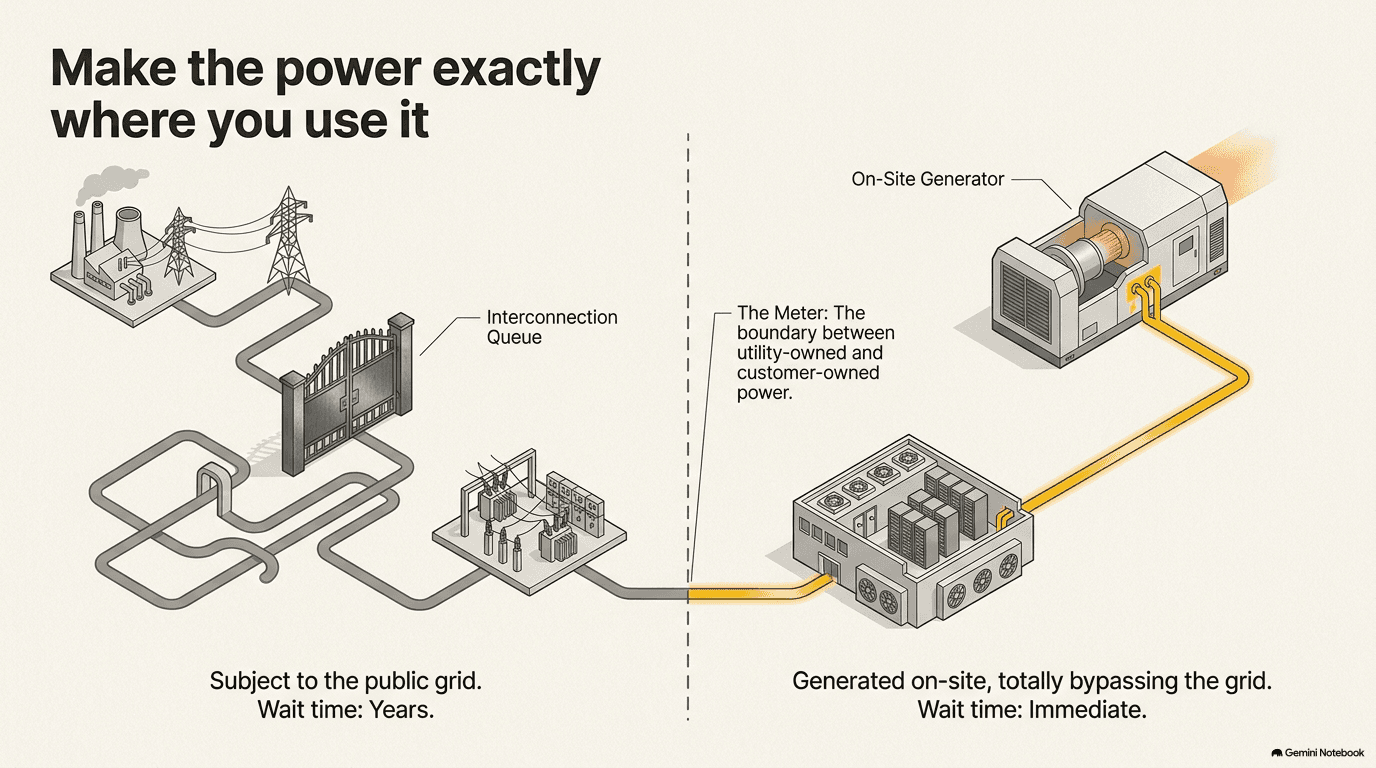
The reason is speed. Connecting any new, large source of demand to the power grid requires something called an interconnection queue — a formal process where a utility studies whether its wires, transformers, and substations can handle the new load without destabilizing the system for everyone else already on it. In many parts of the United States today, that study-and-approval process takes years — in some regions, five to seven years from the day a data center developer asks for power to the day it actually flows. Chapter 4 touched on why power availability has become the single biggest factor in choosing where to build a data center; Chapter 13 will look at "the queue" itself as a system-wide bottleneck. This chapter is about what companies do while they wait, or instead of waiting: they build their own generation.
The scale involved makes the problem worse. A single AI data center campus — not a whole company's footprint, just one campus — can now require more electricity than a mid-sized American city uses. A city that size waited decades for its power infrastructure to be built out gradually, substation by substation. A data center campus wants that same amount of power available on a timeline measured in months, not decades.
There's also a reliability argument. Data centers are built around a promise of near-perfect uptime — the "five nines" standard mentioned in Chapter 4, meaning less than about five minutes of unplanned downtime in an entire year. The public grid, however well run, occasionally has outages: a storm knocks down a line, a piece of equipment fails, demand spikes beyond what the system was sized for. A company that generates at least some of its own power on-site has a layer of control it doesn't get by only plugging into someone else's grid.
It's worth understanding why the interconnection queue takes so long, because the delay isn't paperwork for its own sake — it reflects real physical constraints. A power grid is a single interconnected system, not a set of independent wires: add a large new load in one place, and the change in electrical flow can be felt for miles around, through transformers and transmission lines that were sized decades ago for the demand that existed back then. Before a utility can say yes to a data center asking for hundreds of megawatts (a megawatt is a million watts — enough to power roughly 750 average American homes; a large AI data center campus can need hundreds of them), its engineers have to model how that new load would behave under every plausible condition — a hot summer afternoon when air conditioners are already straining the system, a transmission line unexpectedly going offline, a sudden swing in the output from a wind farm elsewhere on the grid. If the study finds a weak point, the fix is often a new transformer or an upgraded transmission line, and both of those, as later chapters cover, can themselves take years to build. The queue isn't one company being slow; it's the cumulative effect of a grid built for a slower-growing world suddenly being asked to absorb a very fast-growing one.
This is where the term "behind the meter" comes from. Normally, the electric meter is the boundary between "the grid's problem" and "your problem" — everything on the grid side is the utility's infrastructure, everything on your side is yours, and the meter measures what crosses that line. Generation that sits behind the meter serves the data center's load directly, without necessarily routing through the public grid at all. A gas turbine sitting next to a server hall, wired straight into the building, is a behind-the-meter power source. The electricity it makes never has to travel down a public transmission line, wait in an interconnection queue, or compete for capacity with anyone else's demand.
Behind-the-meter power comes in two flavors, and the distinction matters. Some installations stay tied to the grid as a backup or supplement — the on-site plant handles the everyday load, and the grid connection remains available for extra capacity or emergencies. Others go further and become what's called an "islanded" system: a power plant and a data center wired together as a self-contained electrical loop that could, in principle, keep running even with no grid connection at all. An islanded setup is the purest version of "own your own power" — it trades the speed and independence of skipping the queue entirely for the added engineering complexity of running a power plant and a data center as one integrated system, with no larger grid to fall back on if something in that system fails.
Put all of this together and something genuinely new is happening: companies whose entire business is running computers are becoming, in parallel, builders and operators of power plants. That is not a small pivot. Power generation has its own physics, its own safety rules, its own decades-long asset life, and its own supply chains — all of which this chapter now walks through, one technology at a time.
Gas Turbines — The Fast, Proven Option
If a data center operator needs a large amount of new power quickly, the default answer today is a gas turbine. It is the option that combines the shortest build time with a technology that has been proven, at industrial scale, for decades.
What a gas turbine actually is
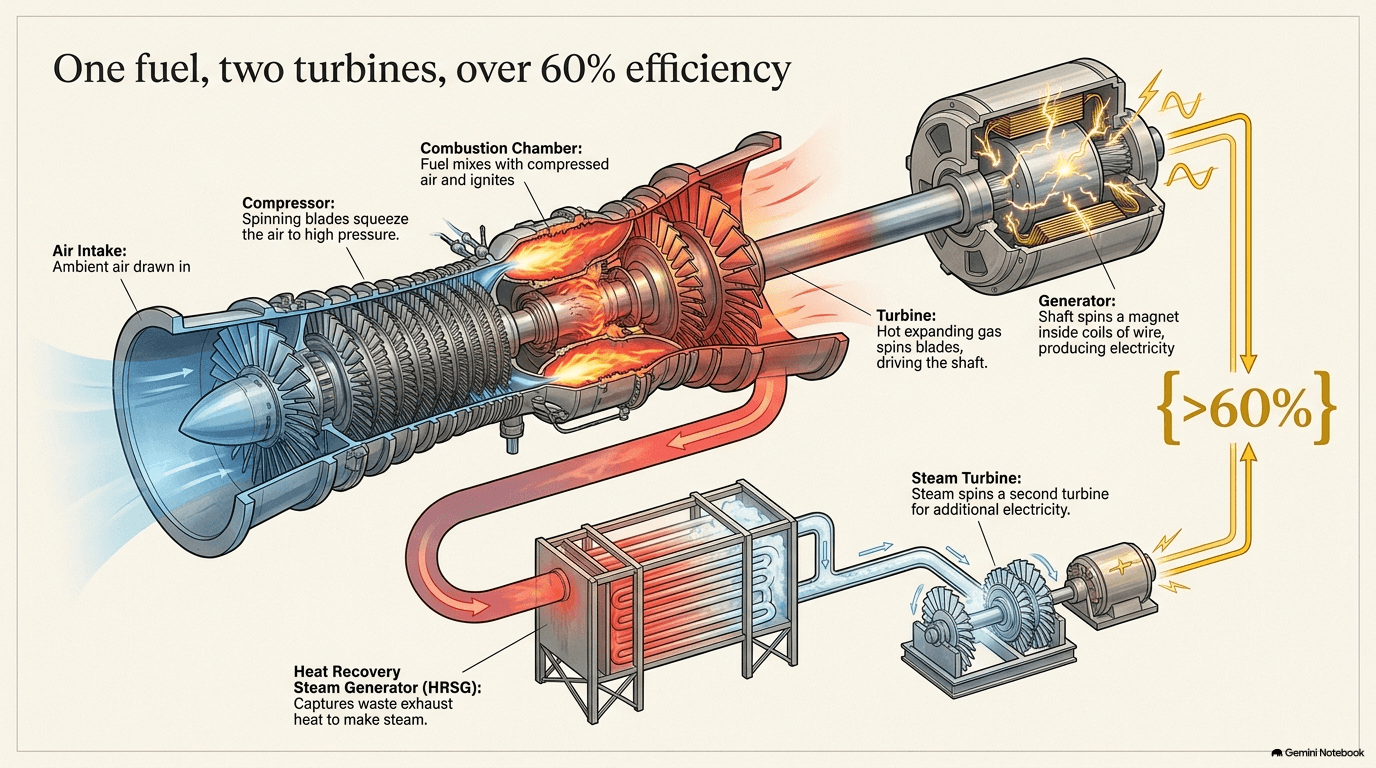
Strip away the size and the industrial setting, and a gas turbine is essentially a stationary jet engine. A jet engine on an airplane burns fuel to produce thrust that pushes the plane forward. A power-generation gas turbine burns fuel to spin a shaft — and that spinning shaft, connected to a generator, is what produces electricity. Same basic machine, different job at the end of it.
The process runs in four steps. First, a compressor — a section of spinning blades at the front of the turbine — pulls in air and squeezes it, raising its pressure and temperature. Second, that compressed air is mixed with natural gas in a combustion chamber and ignited, producing an extremely hot, high-pressure stream of gas — temperatures inside the combustion section can exceed 2,000 degrees Celsius, hot enough to melt most metals outright (which is exactly why the materials used here matter so much, covered below). Third, that hot gas rushes through a set of turbine blades, spinning them at high speed the same way wind spins a windmill, only far more violently. Fourth, the spinning shaft connects to a generator, which converts the mechanical spinning motion into electrical current.
Simple cycle vs. combined cycle
Run a gas turbine on its own — burn the fuel, spin the turbine, make electricity, and let the hot exhaust gas simply vent out the back — and you get what's called simple cycle. It's fast to start and stop, which makes it useful for handling sudden spikes in demand, but a meaningful share of the energy in the fuel leaves as wasted heat in that exhaust.
Combined cycle captures that waste. The hot exhaust from the gas turbine, instead of venting away, is routed through a heat recovery steam generator — essentially a giant boiler that uses the leftover heat to turn water into steam. That steam then spins a second turbine, a steam turbine, producing additional electricity from heat that would otherwise have been thrown away. Bolting these two systems together — a gas turbine and a steam turbine, sharing one fuel source — is how combined-cycle plants reach efficiencies of 60% or higher, meaning more than 60% of the energy locked inside the natural gas actually becomes usable electricity. That is a remarkably high number for any kind of heat engine; for comparison, a simple-cycle turbine alone typically converts closer to a third of its fuel's energy into electricity.
To put the 60%-plus combined-cycle efficiency number in perspective: a typical car engine converts roughly a fifth to a third of the energy in its fuel into motion that actually moves the car forward, with the rest lost as heat out the exhaust and radiator. A combined-cycle gas plant, capturing and reusing its own waste heat through that second steam turbine, gets double or more that fraction of its fuel's energy turned into useful electricity. That's the entire point of bolting the two turbines together — it's not a marginal tweak, it roughly doubles how much electricity comes out of the same amount of natural gas.
Why speed matters here
Compared to almost any other new power source, gas turbines can be designed, manufactured, delivered, and brought online quickly — commonly in one to two years from the decision to build. That is still not fast in absolute terms, but it is fast relative to the alternatives in this chapter, and it's fast enough to matter when a data center campus is trying to get power flowing before a multi-year grid interconnection would even conclude.
Turbines also come in different roles depending on how a data center plans to use them. Some are sized and run as steady, continuous "baseload" generators, providing the same output around the clock the way a nuclear plant would. Others are configured more like "peakers" — units that sit mostly idle and can start up quickly to cover a short-term spike in demand, then shut back down. A gas turbine's ability to start relatively fast (compared to, say, a coal or nuclear plant, which can take many hours to bring online from cold) is part of what makes it useful in both roles.
The dominant maker
GE Vernova is the dominant manufacturer of large gas turbines in the world. To put a number on that dominance: turbines GE Vernova has built and shipped over the decades already generate roughly a quarter of the world's electricity today. That is not a claim about revenue or market share in a financial sense — it's a physical fact about how much of the planet's actual generating equipment carries the company's name. When a data center developer wants a large gas turbine fast, GE Vernova is the name that comes up first, because so much of the installed base — and so much of the industry's manufacturing know-how — sits with that one company.
The supporting cast
A gas turbine is not a single object that arrives and gets plugged in — it's the centerpiece of a larger plant, and building that plant draws on a specific chain of specialized manufacturers.
Babcock & Wilcox builds gas-fired power plants and the boiler and environmental-control systems around them — the equipment that handles emissions and the balance-of-plant infrastructure that surrounds the turbine itself, rather than the turbine's spinning core.
Broadwind makes precision gears — specifically, the gearing that couples a turbine's high-speed rotating shaft to the generator, which typically needs to spin at a different, carefully matched speed. Getting that coupling wrong, even slightly, produces vibration and wear that can damage a machine running continuously for years; the gears have to be machined to very tight tolerances.
Howmet Aerospace casts the turbine blades themselves — specifically the superalloy blades that sit directly in the hottest part of the machine, where temperatures exceed the melting point of the metal they're made from. These blades survive only because of internal cooling channels and specialized alloys developed originally for jet engines (Howmet's roots are in aerospace casting), which is a reminder that a power-generation gas turbine and a jet engine really are close cousins under the skin.
Nuclear — The Long-Term Bet
Where gas turbines are the fast option, nuclear power is the patient one. It offers something gas cannot — carbon-free electricity that runs continuously, day and night, regardless of weather — but it comes with a timeline that, for most projects, stretches well beyond the planning horizon of a single data center buildout.
What nuclear power actually is
At the center of a nuclear reactor is a process called fission: splitting the nucleus of a heavy atom — almost always a form of uranium — into smaller pieces. When that nucleus splits, it releases an enormous amount of energy as heat, along with neutrons that go on to split further nuclei, sustaining a controlled chain reaction. That heat is used to boil water into steam, and the steam spins a turbine connected to a generator — from the turbine onward, the physical process is actually very similar to what happens in the steam-turbine half of a combined-cycle gas plant. The fundamental difference is entirely in how the heat gets made: splitting atoms instead of burning fuel.
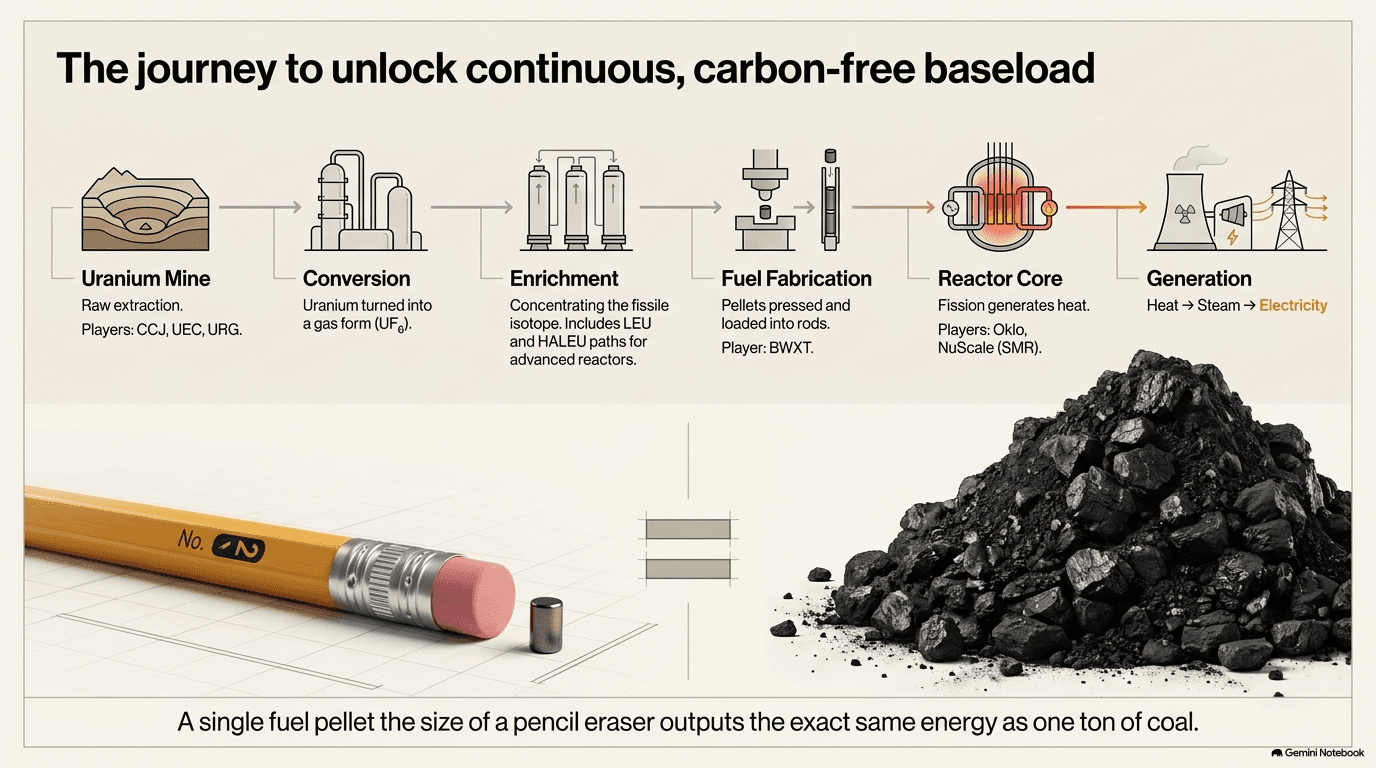
The energy density involved is difficult to overstate with an everyday comparison, but here is one that captures the scale: a single nuclear fuel pellet, roughly the size of a pencil eraser, contains as much usable energy as about a ton of coal. That density is the whole appeal of nuclear power — an enormous amount of energy from a very small, very stable physical package, with no combustion and no carbon emissions from the reaction itself.
That density also explains why a reactor keeps running for so long between refuelings. A gas turbine needs a continuous pipeline of natural gas flowing in every minute it operates; a reactor's fuel assemblies, once loaded, keep splitting atoms and releasing heat for months to a few years before they need to be replaced. It's the difference between a machine that has to be fed constantly and one that's loaded up and then largely left alone — which is part of why nuclear plants are so well suited to providing steady, unchanging baseload power rather than power that ramps up and down to follow demand.
The chain reaction itself has to be carefully controlled, not just allowed to run freely. Left unchecked, a chain reaction where each split atom triggers more than one additional split would accelerate uncontrollably. Reactors use control rods — rods made of materials that absorb neutrons — inserted into or withdrawn from the reactor core to keep the reaction rate steady, holding it at exactly the pace needed to generate a constant, safe amount of heat. Pulling the rods out speeds the reaction up; pushing them in slows it down or stops it. This is, at its core, a thermostat for a nuclear chain reaction.
Why data centers find nuclear attractive
Three qualities line up well with what a data center needs. It's carbon-free at the point of generation, which matters to operators trying to make credible claims about running on clean energy. It runs 24 hours a day, seven days a week, without the intermittency problem that affects solar and wind (covered in section 7.5) — a reactor doesn't care whether the sun is up. And the energy density means a relatively small physical footprint can produce a very large, very steady amount of power — useful for a data center campus that needs continuous "baseload" electricity rather than power that comes and goes.
The catch: time
Here is the honest constraint: a traditional, large-scale nuclear power plant — the kind that has existed since the 1950s — takes a decade or more to plan, permit, and build. That timeline makes conventional nuclear plants a poor match for a data center operator trying to solve a power shortage this decade, not next.
Small Modular Reactors (SMRs)
The idea behind Small Modular Reactors is to shrink that timeline by shrinking the reactor. Instead of a custom-engineered, one-of-a-kind plant built entirely on site over many years, an SMR is designed to be built largely in a factory — in standardized, repeatable modules — then shipped and assembled at the final location, closer to where the power is actually needed, potentially right next to (or very near) a data center campus. The logic is the same one that has reshaped data center construction itself, discussed in Chapter 4: things built in a factory, under controlled conditions, go faster and more predictably than things built entirely on site.
It's important to be direct about where this technology actually stands: as of this writing, no SMR has been commercially deployed and generating power anywhere in the world. Every SMR discussed in the context of AI data centers today is a design, a prototype, or a project under construction — not an operating power source. This is a bet on the 2030s, not a solution available now.
Two of the most-discussed reactor designers are Oklo, which is developing a compact fission design (called Aurora), and NuScale, which holds the distinction of being the only SMR design to have received formal design approval from US nuclear regulators — a real, meaningful milestone, but still a regulatory approval of a design, not a plant generating electricity today.
Design approval matters because nuclear reactors, unlike gas turbines or fuel cells, cannot simply be built and switched on. Every reactor design has to pass through a lengthy formal review by a national nuclear safety regulator — in the US, the Nuclear Regulatory Commission — that examines the design's safety systems, its behavior under accident scenarios, and its construction methods, before any company can build and operate one. That review process is a large part of why nuclear timelines run so much longer than gas or fuel cells: it's not simply an engineering and construction problem, it's a regulatory one layered on top.
The nuclear fuel chain — a sequence, not a single product
Getting uranium out of the ground and into a working reactor is not one step; it's a chain of very different industrial processes, each performed by different kinds of specialized companies.
1. Mining. It starts underground (or, for some deposits, using a technique that dissolves uranium out of rock formations without conventional digging). Cameco is one of the world's largest uranium miners. Uranium Energy and Ur-Energy are other miners active in extracting uranium ore from the ground.
2. Conversion. Raw mined uranium, in the form it comes out of the ground, isn't usable in a reactor. It first has to be converted into a gas form — a chemical processing step that prepares the uranium for the next stage, enrichment.
3. Enrichment. Natural uranium contains only a small fraction of the specific isotope — a variant of the uranium atom — that actually sustains a fission chain reaction. Enrichment is the process of concentrating that fissile isotope to a higher percentage. Centrus Energy runs the only enrichment operation in the United States licensed to produce HALEU — high-assay, low-enriched uranium — the more concentrated fuel that many of the newer advanced reactor designs, including several SMRs, are engineered to use. That single-license status makes Centrus a genuine chokepoint in the US supply chain specifically for this newer class of reactor fuel.
4. Fuel fabrication. Enriched uranium then has to be shaped into the physical fuel assemblies that actually get loaded into a reactor core — precisely engineered rods and pellets designed to hold up under years of intense heat and radiation. BWX Technologies fabricates nuclear fuel and reactor components, work that spans both commercial reactor fuel and other nuclear applications.
5. Load into the reactor. The finished fuel assemblies go into the reactor core, and fission — the process described above — begins, generating heat that ultimately becomes electricity.
Beyond the existing mining base, NexGen is notable for developing a major new uranium deposit — the kind of large-scale mining project that a growing reactor fleet, including any real expansion of SMRs, would eventually need to draw on.
The honest bottom line
Nuclear is the long game. It offers something gas turbines structurally cannot — clean, always-on power — but at a stage of development, particularly for SMRs, that is measured in years of design and regulatory work still ahead, not months of construction. A data center operator solving today's power shortage reaches for a gas turbine. A data center operator planning for the 2030s is the one signing early nuclear agreements now.
Fuel Cells — Electricity Without Combustion
Between the fast-but-still-months timeline of gas turbines and the years-away promise of nuclear sits a third option that behaves almost nothing like either one: the fuel cell. A fuel cell makes electricity directly from a chemical reaction — no flame, no combustion, and, in some designs, no moving parts at all.
What a fuel cell actually is
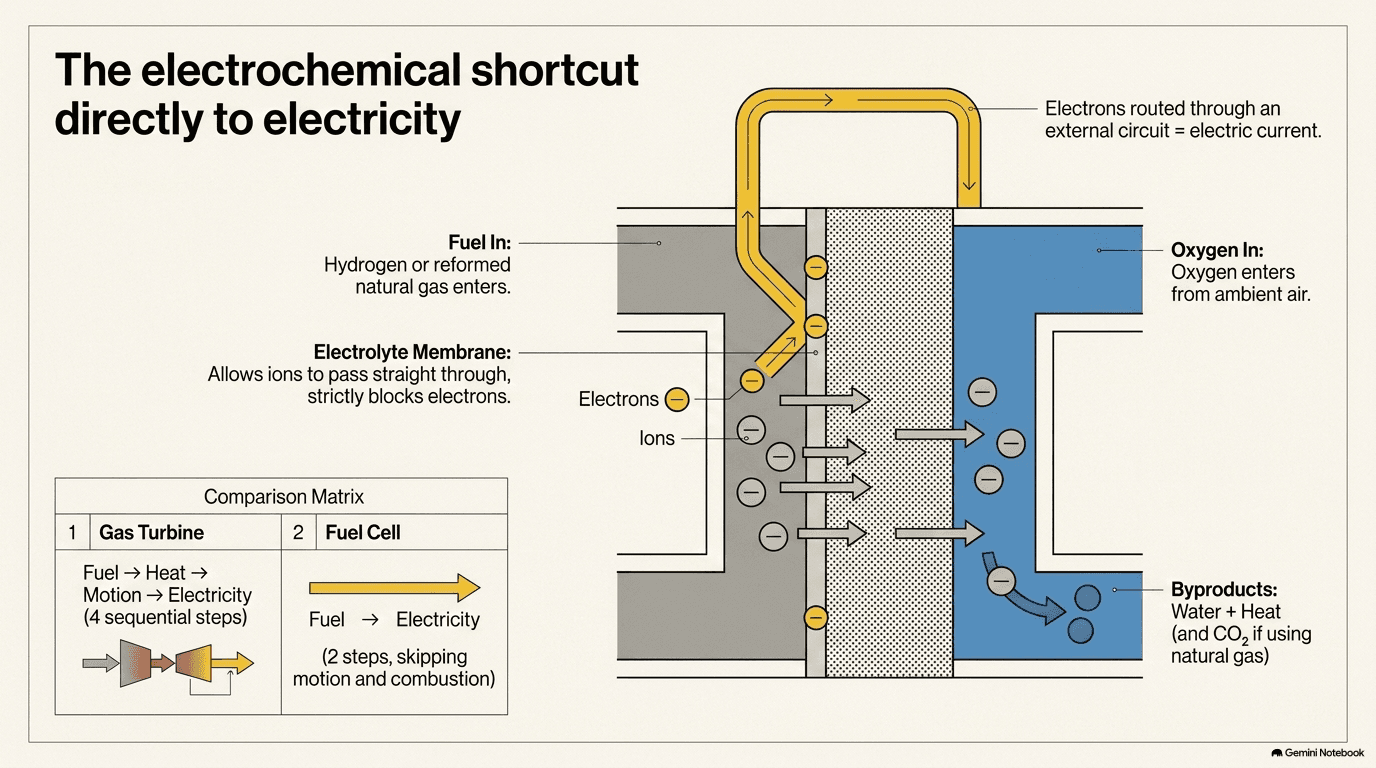
A fuel cell converts a fuel — either hydrogen or natural gas, depending on the design — directly into electricity through a controlled chemical reaction, rather than by burning that fuel to create heat and spinning motion the way a turbine does. The comparison worth holding in mind: a gas turbine is fundamentally a heat engine, converting fuel into heat into motion into electricity. A fuel cell skips the heat-and-motion steps entirely and produces electric current straight from the chemistry.
Here's the mechanism. A fuel cell has two sides separated by a special material called an electrolyte membrane — a barrier that allows certain charged particles (ions) to pass through it but blocks others. Fuel is fed to one side; oxygen (typically just from the surrounding air) is fed to the other. A chemical reaction at each side strips charged particles loose. Ions cross through the membrane from one side to the other, but the electrons freed up by the same reaction are forced to take a longer route — through an external circuit that connects the two sides. That flow of electrons, forced through the circuit rather than straight across the membrane, is the electric current the fuel cell produces. The byproducts, depending on the fuel used, are typically just heat and water (for hydrogen) or heat and carbon dioxide (for natural gas).
A simple way to think about it: a fuel cell behaves something like a battery that never runs down, as long as fuel keeps flowing in. A battery stores a fixed amount of chemical energy and depletes as you use it. A fuel cell doesn't store energy at all — it converts fuel to electricity continuously, for as long as fuel keeps arriving, the same way a car doesn't run out of "engine" as long as it has gasoline.
There isn't just one type of fuel cell. Different designs use different electrolyte materials and run at different temperatures, and those differences shape what each type is good at. Solid-oxide fuel cells — the kind Bloom Energy builds — use a solid ceramic electrolyte and run hot, which lets them accept a wider range of fuels, including natural gas directly, without needing it converted to pure hydrogen first. Other designs, like proton-exchange-membrane cells, run cooler and need pure hydrogen as their fuel input, which adds an extra processing step upstream but can make the cell itself smaller and quicker to start. The chemistry differs, but the underlying trick — ions crossing a membrane, electrons routed through a circuit — is the same across every type.
Fuel cells are also inherently modular. A single fuel cell produces a fairly small amount of electricity, so real installations stack many individual cells together — first into a "stack," then multiple stacks into a larger system — to reach the amount of power actually needed. That modularity is part of what makes fuel cells easy to scale up incrementally: adding capacity can mean adding more identical stacks, rather than engineering an entirely larger machine the way a bigger gas turbine requires a fundamentally bigger design. This same modular building-block approach, well before AI data centers existed, is why fuel cells were already a familiar backup and primary power source for hospitals, retail stores, and telecom equipment sites that needed steady, reliable power in a compact footprint.
Why fuel cells fit a data center's needs
Several qualities make fuel cells appealing specifically for this use case. They're clean at the point of generation, especially when run on hydrogen. They're quiet, with no combustion and, for solid-oxide designs, no large spinning parts — a meaningful difference from a gas turbine, which is a loud industrial machine. They stay efficient even at fairly modest scale, unlike some power technologies that only make economic and technical sense at very large size. And critically for a company trying to solve a power problem quickly, fuel cell installations can be deployed fast — in a matter of weeks, not the months required for a gas turbine or the years required for nuclear.
The players
Bloom Energy makes solid-oxide fuel cells that are already installed and running at data centers today — this is not a future technology in the way SMRs are; it's operating now. One detail worth connecting back to Chapter 6: Bloom's fuel cells can output electricity directly at 800 volts DC. That matters because the data center industry, as covered in Chapter 6, is shifting its internal power architecture toward exactly that voltage — 800V DC — to handle the enormous currents that modern AI chips demand. A fuel cell that natively produces 800V DC output plugs more directly into that emerging architecture than power sources that generate a different voltage or alternating current requiring extra conversion steps.
FuelCell Energy works with a different fuel cell chemistry (molten carbonate — using a hot liquid salt mixture as the electrolyte instead of a solid ceramic — rather than Bloom's solid-oxide approach) and has been repositioning its business specifically around data center power demand.
The speed advantage, in context
Set the three technologies covered so far side by side on one dimension — how fast can they actually be installed and start producing power — and the ordering becomes clear: a fuel cell installation can go in over a matter of weeks; a gas turbine plant takes roughly one to two years; a nuclear plant, traditional or modular, is a multi-year-to-decade undertaking. That doesn't make fuel cells the best choice in every situation — they don't yet match the sheer scale that a large gas turbine or fleet of turbines can deliver — but for filling a gap quickly, or adding incremental capacity to a site that's already under construction, they're the fastest tool available.
Renewables and the 24/7 Problem
Solar and wind are, in many parts of the world today, the cheapest way to build new electricity-generating capacity. That makes them an obvious ingredient in a data center's power mix — and also, because of one unavoidable physical fact, an incomplete one on their own.
The economics and the contracts
A large data center operator generally doesn't build and operate its own solar farm or wind farm the way it might build a gas turbine plant on its own campus. Instead, it typically signs a Power Purchase Agreement, or PPA — a long-term contract in which the data center operator agrees to buy the electricity output of a specific renewable energy project, often for a decade or more, at an agreed price. The developer building the solar or wind farm uses that contracted revenue to help finance construction of the project in the first place. A PPA doesn't necessarily mean the electrons from that specific solar farm are the ones physically flowing into that specific data center — power grids blend electricity from many sources — but it does mean the data center operator is financially responsible for, and can claim credit for, that amount of renewable generation being added to the grid.
The hard limit
Here is the physical fact that no amount of engineering cleverness has yet fully solved: the sun sets every day, and the wind sometimes doesn't blow. A data center, by contrast, needs power every single second, continuously, with essentially no tolerance for interruption. That mismatch — intermittent generation against continuous demand — is renewable energy's fundamental limitation for this particular use case.
The consequence is straightforward: solar and wind alone, without an enormous amount of battery storage layered on top to bank power for the hours when the sun isn't shining or the wind isn't blowing, cannot run a data center around the clock on their own. They can meaningfully reduce how much power comes from other sources, and they can be the cheapest electrons on the grid when they are available, but by themselves they are not a complete answer to a facility that never stops running.
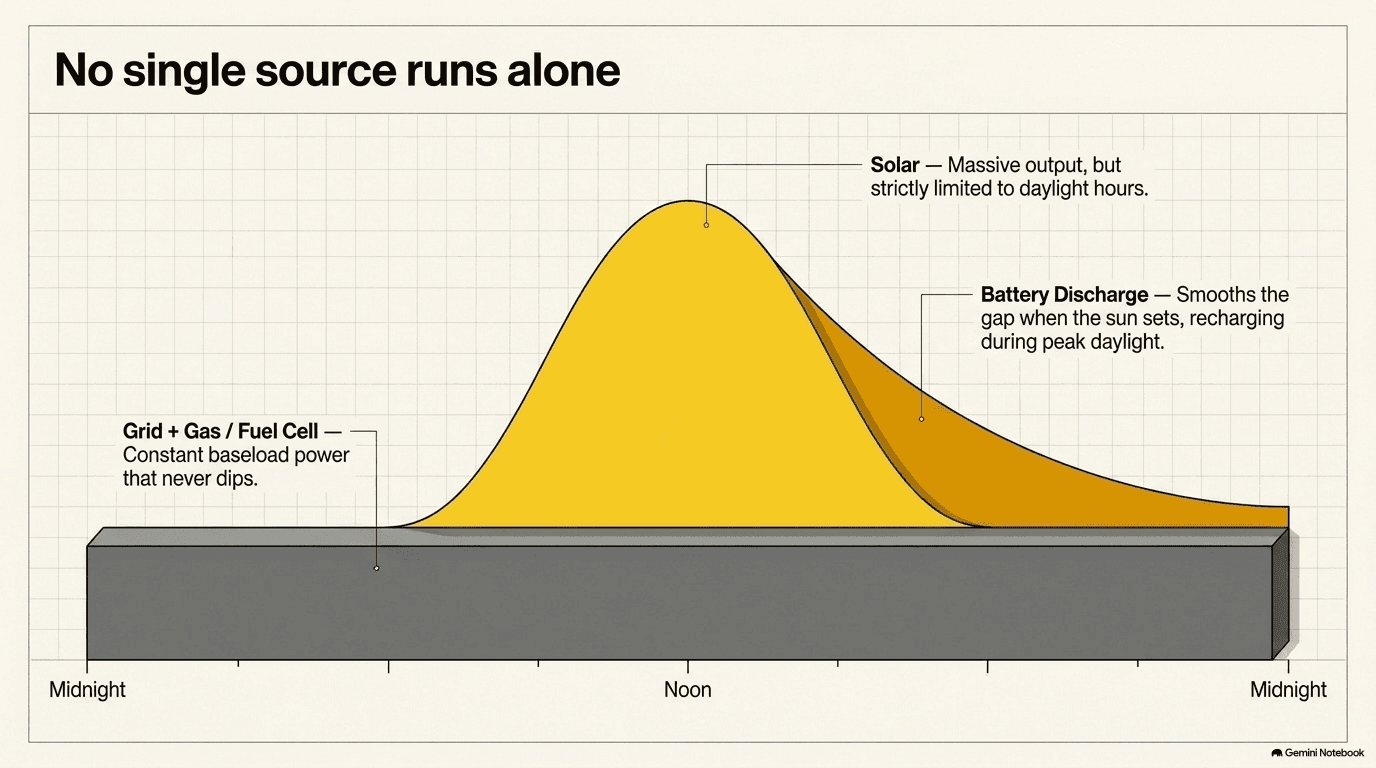
Batteries help close that gap, but even batteries have a physical limit worth understanding: they store a finite amount of energy and can only discharge it for so many hours before running empty and needing to recharge. A battery system sized to cover a few hours of evening demand, after the sun goes down, is a very different (and very much smaller) proposition than a battery system sized to carry a data center through an entire cloudy week. Today's grid-scale batteries are generally built and deployed to smooth out hours, not days — shifting solar power from afternoon into evening, for instance — rather than to substitute for weeks of missing generation. That's precisely why the industry blend described below still leans on always-on sources like gas turbines, fuel cells, or eventually nuclear for the baseload a data center can't do without, and treats solar-plus-storage as an addition on top rather than a replacement.
Wind power follows the same basic intermittency logic as solar, just on a different schedule — wind speeds rise and fall through the day and across seasons rather than following the fixed, predictable rhythm of sunrise and sunset, which in some ways makes wind's output even harder to plan around precisely. In practice, data center power agreements today lean more heavily on solar than wind, partly because solar projects tend to be faster and simpler to permit and build, but both are typically contracted the same way, through the PPA structure described above, and both face the identical requirement for storage or another always-on source to fill in the gaps.
The companies making the hardware
First Solar is the largest solar panel manufacturer based in the United States — notable, in a supply chain sense, less for any particular technical breakthrough than for being a rare instance of large-scale solar panel manufacturing capacity located domestically, at a time when most panel manufacturing capacity sits overseas.
Enphase is developing a solid-state transformer (a device that changes voltage levels using electronic switching circuits instead of the heavy copper-wound coils in a traditional transformer — smaller, more controllable, and better suited to the DC power systems described in Chapter 2) specifically designed for 800V data center power architecture — another example, alongside Bloom Energy's fuel cells, of a power-generation-adjacent company building equipment aimed directly at the voltage shift described in Chapter 6.
Solar panels don't just sit flat and fixed — many utility-scale solar installations use trackers, motorized mounting systems that slowly tilt panels throughout the day to follow the sun's position across the sky, capturing meaningfully more sunlight than a fixed panel would. Array Technologies and Nextracker both make these solar trackers.
Canadian Solar makes solar panels but is increasingly selling battery storage systems alongside them — the pairing that starts to address the 24/7 problem directly, by storing daytime solar generation for use after dark.
How it actually comes together in practice
No large data center campus today relies on a single power source. In practice, big campuses blend several of the technologies covered in this chapter: the grid (where available) and gas turbines or fuel cells provide steady, always-available baseload power; solar paired with batteries adds a layer of lower-cost, cleaner generation on top, shifted in time by the batteries to cover at least part of the night; and nuclear, where a project has actually been built, would eventually sit in that baseload role as well, once the technology matures past today's development stage.
The Power Mix — Blending It All Together
Step back from the individual technologies, and a clear pattern emerges: not one of them wins on every dimension that matters.
Gas turbines are fast to build and technically proven at massive scale, but they run on a fossil fuel and are not carbon-free. Nuclear is clean and runs continuously with no intermittency problem at all, but — at least for the newer, smaller reactor designs most relevant to data centers — it remains years away from actual commercial operation. Fuel cells are clean, quiet, and can be installed remarkably fast, but they haven't yet been deployed at anything close to the scale a gas turbine or a large power plant can provide. Renewables are frequently the cheapest form of new generation and produce no emissions at the point of generation, but the sun and the wind are not under anyone's control, and without extensive battery storage they cannot, by themselves, supply power every hour of every day.
| Source | Speed to build | Runs 24/7? | Carbon-free? | Proven at large scale? | |---|---|---|---|---| | Gas turbine | 1-2 years | Yes | No | Yes | | Nuclear / SMR | Years to a decade+ | Yes | Yes | Traditional nuclear: yes. SMRs: not yet deployed. | | Fuel cell | Weeks | Yes, as long as fuel supply continues | Depends on fuel (cleaner with hydrogen) | Not yet, at gas-turbine scale | | Solar + wind | Months to years for the project; fast per-unit | No, without storage | Yes | Yes, but intermittent |
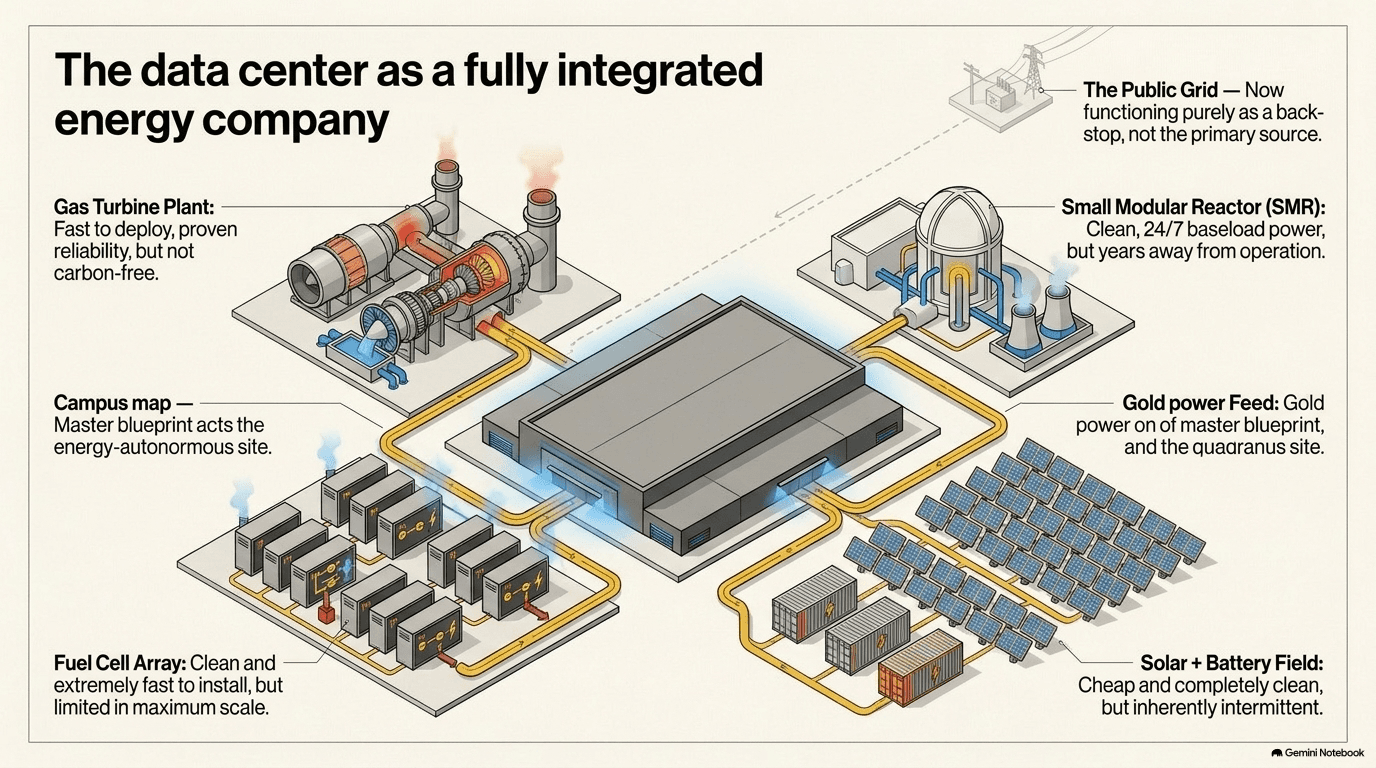
The pattern that's emerging across the industry is not a single winning technology — it's a layered blend, with several sources stacked together and the public grid kept in reserve as a backstop rather than the sole supplier. A campus might run gas turbines or fuel cells for steady baseload power today, sign long-term contracts for solar and storage to add cheaper clean capacity on top, and simultaneously pursue a nuclear agreement aimed at supplying power a decade from now, once that technology has matured. All the while, the connection to the public grid — the traditional, in-front-of-the-meter path described in section 7.1 — remains in place as backup and as a source of additional capacity if and when the interconnection queue finally clears.
This is a genuinely new position for the data center industry to be in. Companies whose core business has always been running computers are now, out of necessity, becoming builders and operators of power infrastructure — signing turbine orders, uranium supply agreements, and fuel cell installations the way they once signed leases for office space and server racks. The building described in Chapter 4, the cooling systems in Chapter 5, and the internal power-delivery cascade in Chapter 6 all assumed electricity simply arrived at the property line. Chapter 7 is the layer where, increasingly, it doesn't — the data center makes its own.
Next: Chapter 8 — Grid, Gas, and Fibre from Outside (the public infrastructure a data center still depends on, even with power of its own)
Companies in this part of the buildout: Power Generation