Chapter 8
Grid, Gas, and Fibre from Outside
A data center doesn't generate its own electrons, drill its own gas, or invent its own internet — it plugs into three vast networks that were built over the last century for a very different kind of demand, and now finds itself as their newest and hungriest customer.
The Electrical Grid — How Power Gets There
Chapter 6 followed electricity on the last leg of its journey — from the point it enters a data center to the moment it reaches a single transistor at about one volt. This chapter starts earlier. Before power reaches the building's front door, it has already traveled through one of the largest machines ever built by humans: the electrical grid.
Think of the grid as a giant, invisible plumbing system, except instead of water it moves electrons, and instead of pipes it uses wires. Unlike water, electricity can't easily be stored in bulk — with small exceptions like the batteries covered in Chapter 6 — so the grid has to produce exactly as much power as everyone is using, at every single moment, and get it to the right place instantly. That balancing act, performed continuously across an entire country, is what the grid actually does.
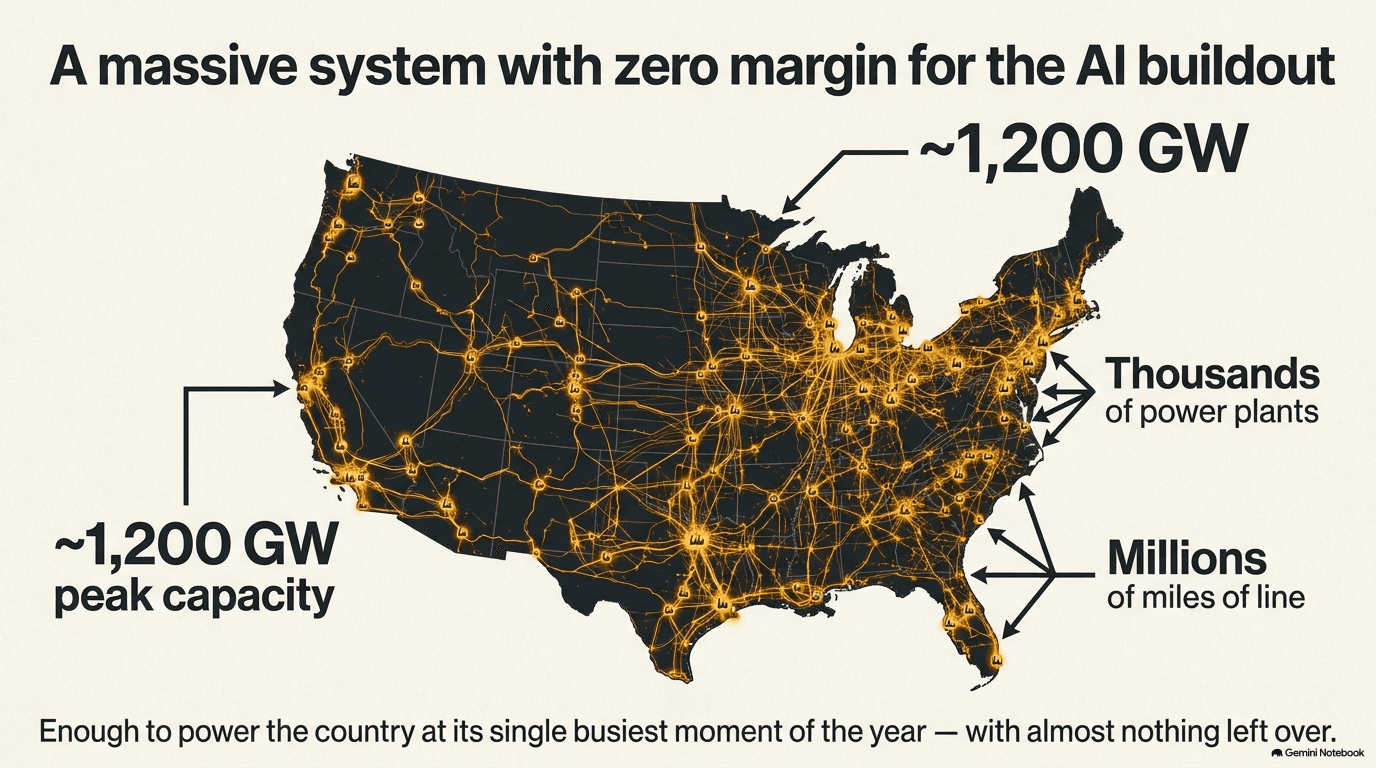
It's also, in an important sense, a single connected machine rather than a collection of separate local systems. Most of the country's grid is stitched together into a few large interconnected regions, and within each region, every power plant and every customer is effectively on the same shared system — in the electricity world, how much power something draws is called its "load," and that load has to be balanced against generation at every instant — if a large power plant on one side of a region suddenly goes offline, it can affect voltage and reliability hundreds of miles away, on the other side of the same interconnection. Grid operators exist specifically to watch this balance in real time and call on power plants to ramp production up or down, second by second, to keep the whole system in equilibrium. A data center that suddenly draws (or, when it powers down a training run, suddenly stops drawing) an enormous and abrupt amount of power isn't just a billing event for its utility — it's a real disturbance the operator has to manage, which is part of why utilities study new large loads so carefully before connecting them.
Three layers: generation, transmission, distribution
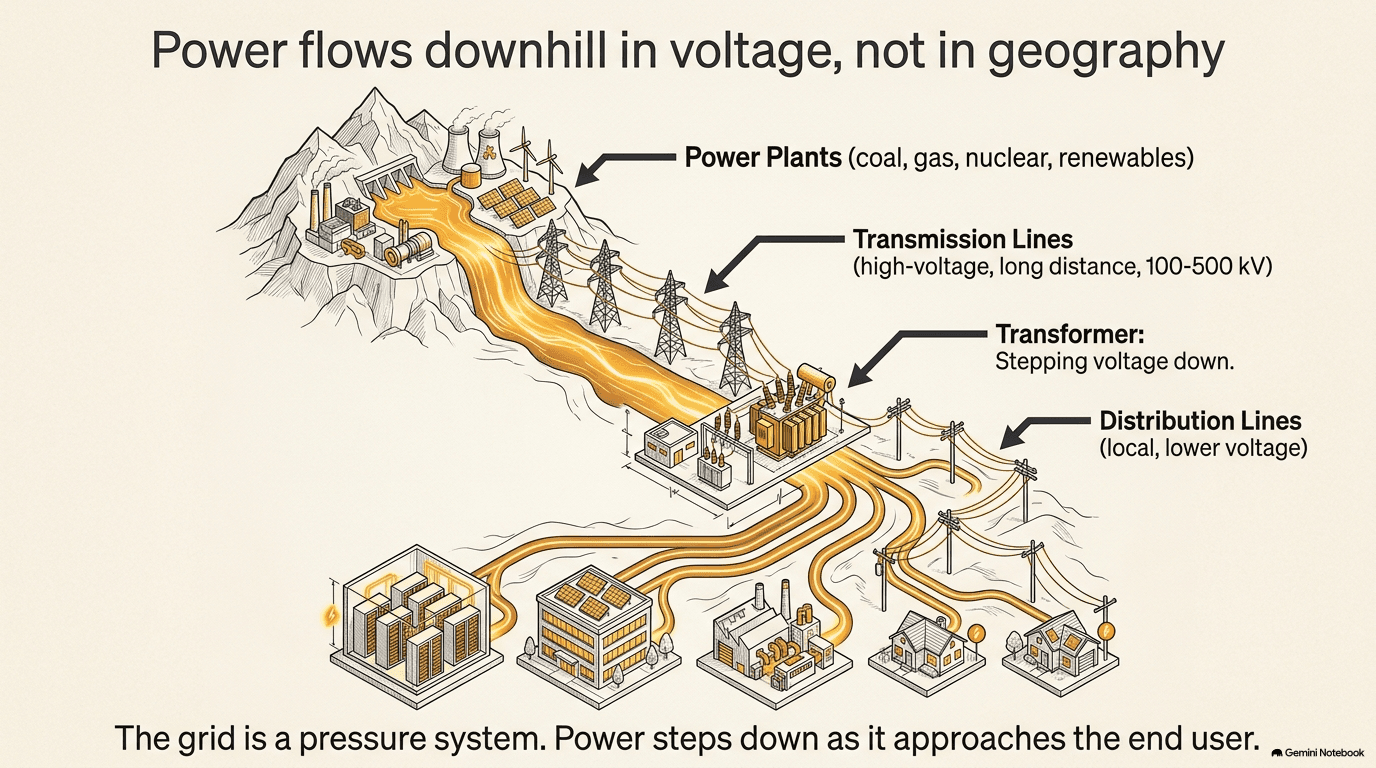
The grid has three layers, and it helps to picture them like a river system flowing from a mountain reservoir down to individual garden hoses.
Generation is the mountain reservoir — the power plants. These can burn natural gas or coal, split uranium atoms (nuclear), spin turbines with wind or falling water, or convert sunlight directly into electricity (solar). Chapter 7 covered the version of this that a data center builds for itself, on its own site. This chapter is about the version that already exists, built by someone else, decades before any data center showed up.
Transmission is the river itself — the long-distance highways of electricity. These are the tall steel towers you see marching across open country, carrying wires at very high voltage (typically 69,000 to 345,000 volts, sometimes higher). High voltage matters here for the same reason it matters inside a building's power cascade (Chapter 6): pushing the same amount of power through a wire at a higher voltage means less current, and less current means less energy wasted as heat over long distances. Sending power across a state at household voltage would lose most of it to heat before it arrived; sending it at 345,000 volts loses only a small fraction.
Distribution is the network of smaller pipes that finally reaches your house or a data center's fence line — lower-voltage local wires, usually running along streets on wooden poles or buried underground, delivering power at the voltage a building's own transformers (Chapter 6) can accept.
Connecting each layer is the humble but essential transformer — the device introduced in Chapter 6 that steps voltage up for the long haul and back down for local delivery. A transformer at a power plant steps generation voltage up to transmission voltage. A transformer at a substation steps transmission voltage down toward distribution voltage. Another transformer, often the last piece of equipment before power reaches a customer, steps it down again to something a building can use. The entire grid, from mountain to garden hose, is really just generation plus a long relay of transformers.
Who owns the wires: the regulated utility
Most of the wires that make up the grid, especially the local distribution network, are owned by a regulated utility — a company that has been granted something close to a legal monopoly to sell electricity in a specific territory. In exchange for that monopoly, the utility doesn't get to charge whatever it wants. A government body called a public utility commission (or public service commission, depending on the state) reviews the utility's costs and sets the prices it can charge customers.
This arrangement exists because building parallel sets of power lines down every street — one for each competing electricity company — would be wildly wasteful. It makes more economic sense to let one company build and maintain the wires, and then regulate how much it can profit from that monopoly.
When a utility needs to spend money on new infrastructure — bigger transmission lines, new substations, upgraded equipment to serve a large new customer — it typically files what's called a rate case with its regulator. In a rate case, the utility lays out the spending it wants to undertake and asks permission to recover that cost, over time, through the rates it charges customers. The regulator can approve, reduce, or reject the request, and often negotiates the terms. This is the mechanism by which the grid actually gets bigger: not through a company simply deciding to build, but through a regulated, monitored process that balances the cost of new infrastructure against the impact on everyone's electric bill.
Dominion Energy is the regulated utility serving Northern Virginia, home to the densest concentration of data centers on Earth — an area in the industry nicknamed "Data Center Alley." A single utility, with a fixed and slowly growing set of wires and substations, now finds a large and rapidly growing share of its territory's electricity demand coming from one type of customer: data centers. Other utilities facing similar pressure from concentrated data center growth in their territories include Entergy in the Gulf South, DTE Energy in Michigan, Xcel Energy across the Upper Midwest and Colorado, and NextEra Energy, whose Florida utility subsidiary serves one of the country's fastest-growing states.
Why the grid is suddenly strained
For roughly fifteen years leading up to the AI boom, total US electricity demand barely grew. Homes and businesses became more energy-efficient — better insulation, LED lighting, more efficient appliances — and that efficiency mostly offset the effect of a growing population and economy. Utilities planned for slow, predictable growth, and the grid was built to match.
Data centers broke that pattern. A single large AI data center campus can request as much power as a mid-sized city, and it wants that power delivered on a timeline measured in months or a couple of years, not the decade or more that utility planning cycles traditionally assumed. In many utility territories, data centers are now the single fastest-growing category of electricity demand — in some cases, the only meaningfully growing category at all.
The interconnection queue: the years-long line to plug in
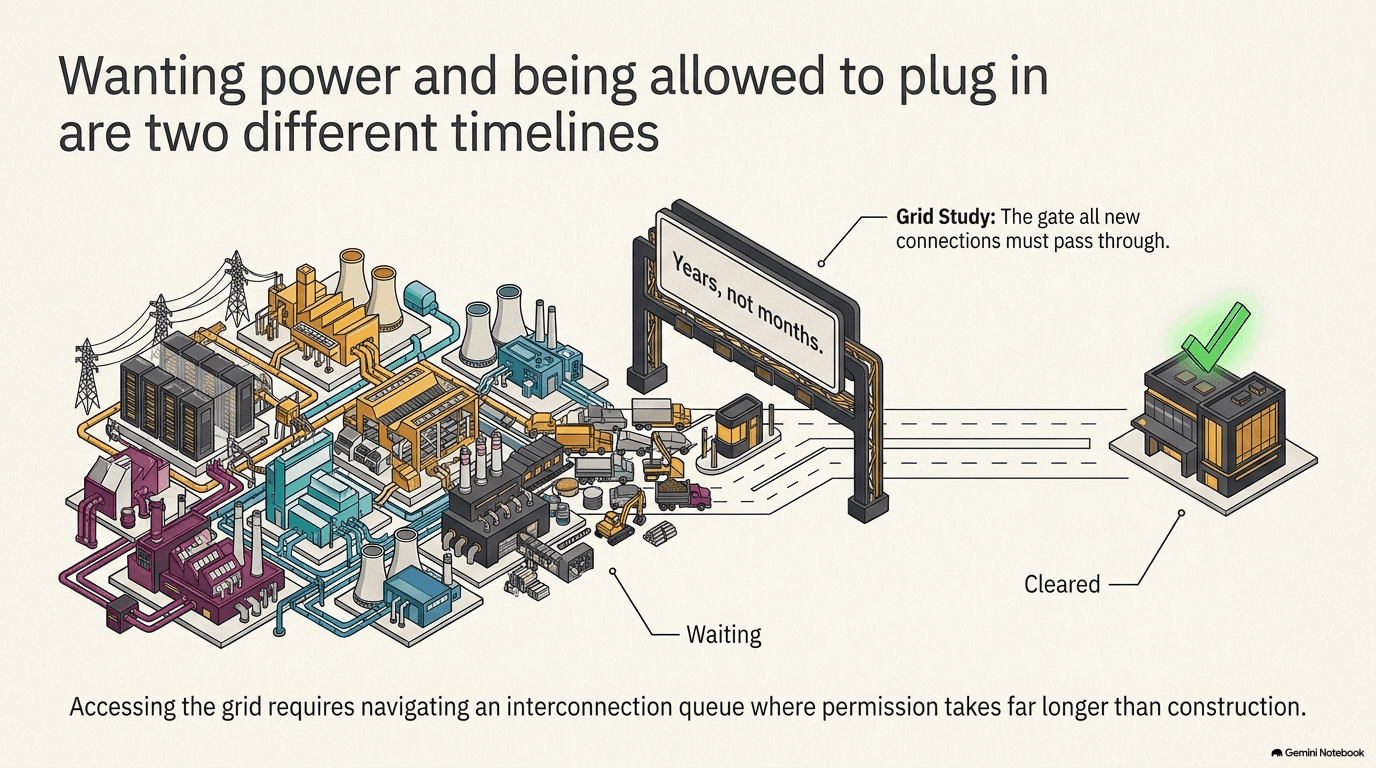
Before any large new customer — a data center, a factory, a power plant — can connect to the grid, the local utility or grid operator has to study whether the existing wires and equipment can actually handle the new load (or, for a new power plant, whether the grid can absorb the new supply) without overloading anything downstream. This study process, and the waiting list of projects sitting in it, is called the interconnection queue.
Think of it like being one more person joining a group video call — one more person is easy. But if a thousand more people try to join at once, someone has to check whether the video-conferencing service has enough capacity, and in what order the new joiners should be let in without crashing the whole call for everyone else. The interconnection study does the electrical version of that check: it asks whether every piece of equipment upstream — wires, transformers, substations — can carry the added load without exceeding its rated limits, and if not, what upgrades would be needed and who pays for them.
In congested regions, especially places where many large projects are trying to connect at the same time, this queue can take years to clear. A data center developer might sign a lease, design a building, and order equipment, only to find that the actual electrical connection — the thing that makes the building useful — is the longest pole in the tent. This queue problem, and the various ways the industry is trying to work around it, comes back in more detail in Chapter 13 (The Queue).
Independent Power and Existing Nuclear
Not every electron a data center uses comes from a regulated utility selling at a regulator-approved rate. In parts of the United States, electricity is sold through competitive wholesale markets — auctions where power plant owners bid to sell electricity, and prices move up and down based on supply and demand, somewhat like a commodity market. The companies that own power plants and sell into these markets, without also owning the local delivery wires, are called independent power producers, or IPPs.
This matters for the AI buildout because of an unusual dynamic: some of the most valuable power plants in the country, for data center purposes, are ones that were built decades ago and were, until recently, unglamorous.
Why old nuclear plants suddenly became prized assets
A nuclear power plant has a specific combination of qualities that almost nothing else offers at scale: it produces a very large amount of electricity, it produces essentially no carbon emissions while operating, and — critically for a data center that must never lose power — it runs continuously, 24 hours a day, 365 days a year, regardless of weather, time of day, or wind speed. Solar only works when the sun is up. Wind only works when the wind blows. A nuclear plant just runs.
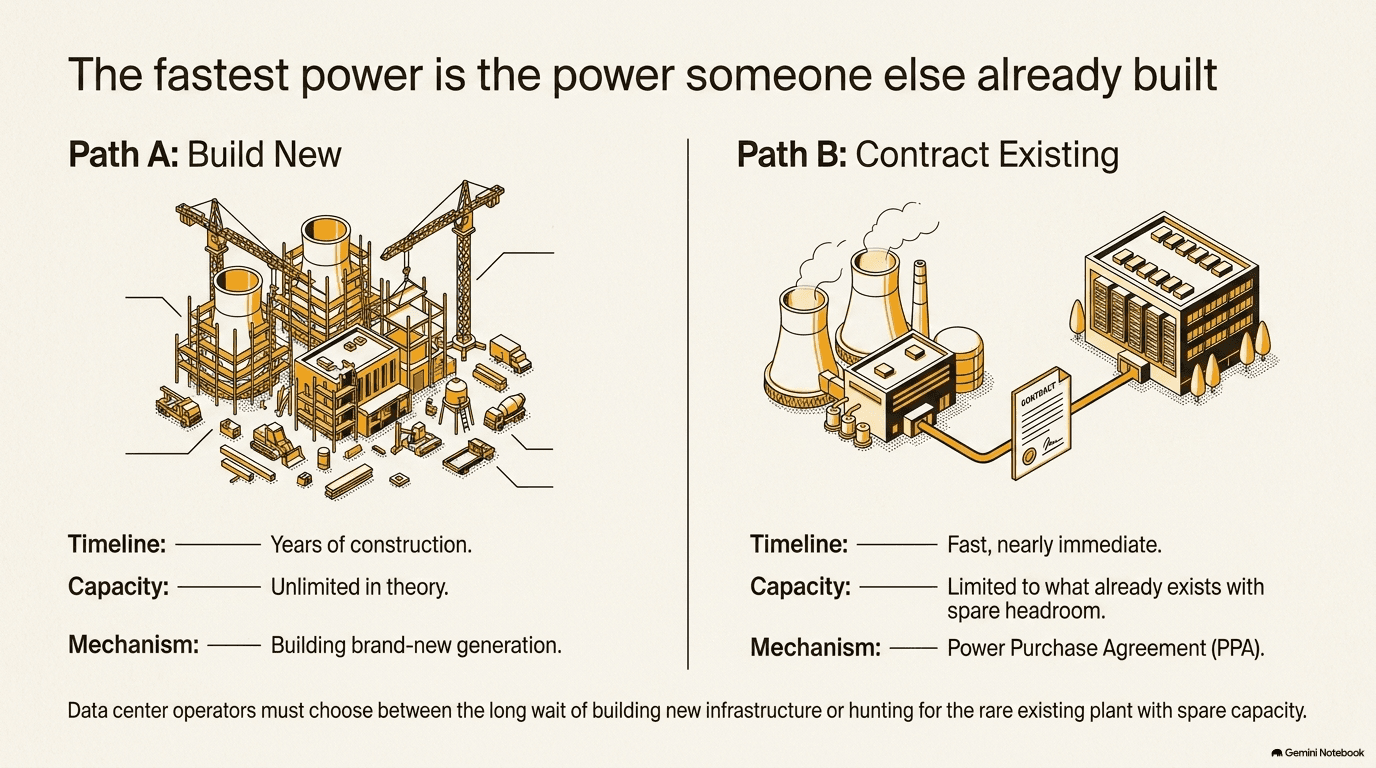
This is a different story from the small modular reactors covered in Chapter 7. Those are new designs, not yet built at commercial scale, representing a bet on future technology. The nuclear plants in this chapter already exist. They were built, licensed, and have been generating power for years or decades — some since the 1970s. For a hyperscaler that needs enormous, reliable, clean power now rather than in the 2030s, an existing nuclear plant is a shortcut past the entire multi-year construction timeline that a new power plant of any kind requires.
Constellation Energy operates the largest fleet of nuclear power plants in the United States. In one of the more striking moves of the AI buildout, Constellation agreed to restart a reactor at the Three Mile Island site in Pennsylvania — the same site where a different reactor suffered a partial meltdown in 1979, the most famous nuclear accident in US history. The reactor being restarted is a separate, undamaged unit that had been shut down for economic reasons years earlier — specifically to sell its power to a data center operator under a long-term agreement. Restarting a mothballed nuclear plant, rather than building a new one from scratch, illustrates just how valuable existing, licensed, already-built generation has become.
Vistra operates a large fleet that includes nuclear generation, and has been contracting portions of that output for data center use as well. Talen Energy took the logic a step further: it owns a nuclear plant located directly adjacent to a data center campus, and sells power from that plant straight to the campus next door — about as short a supply chain as electricity delivery can get, skipping most of the transmission-and-distribution journey described in section 8.1 entirely.
Locking up existing supply instead of building new supply
The pattern across these deals is the same: rather than waiting years for new generation to be built (Chapter 7) or years for a grid interconnection study to clear (section 8.1), a data center operator signs a long-term contract to buy the output of a power plant that is already running. It's the difference between building a new well and simply signing a long lease on an existing one that's already producing water. The plant doesn't get bigger or faster to build — it's already built. What changes is who gets to buy its output, and for how long.
This strategy has limits. There are only so many existing large power plants in the country, and only some of them sit near land suitable for a data center or near transmission capable of delivering their output to one. As the easiest of these deals get signed, the remaining path back to section 8.1's slower, more traditional grid connection — or Chapter 7's build-your-own-generation route — becomes the more common one again.
Natural Gas — The Fuel Chain
Chapter 7 introduced the gas turbine as one of the fastest ways for a data center to get its own dedicated, on-site power. But a gas turbine is just an engine — it needs fuel, and the fuel is natural gas. This section follows that gas backward, from the burner tip in a turbine all the way to the ground it came from.
From the ground to the burner: the physical journey
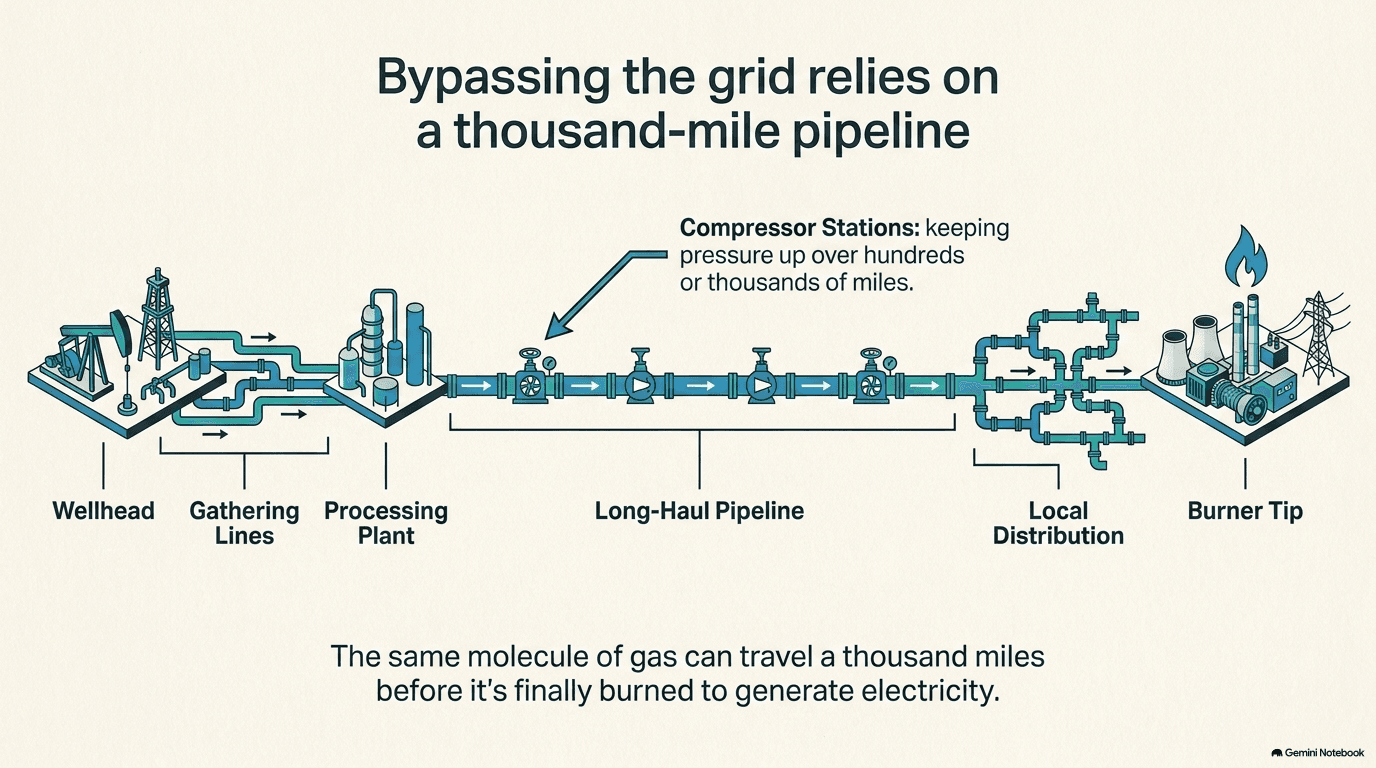
Natural gas starts as a gas trapped underground, often alongside oil deposits, and reaches the surface through a wellhead — the valve and piping structure at the top of a drilled well. From there it travels through gathering lines, smaller local pipelines that collect gas from many nearby wells and bring it to a central point.
At a processing plant, the raw gas is cleaned up: water vapor, and other gases and liquids mixed in with the methane (natural gas's main component) are stripped out, so what remains is pipeline-quality gas that meets the specifications every downstream pipeline and burner expects. From there, gas enters the long-haul pipeline network — large-diameter steel pipes, often buried several feet underground, that can move enormous volumes of gas across hundreds or thousands of miles, from producing regions to the places that consume it. Along the way, periodic compressor stations — essentially large pumps for gas rather than liquid — re-pressurize the gas to keep it moving, the same way a long garden hose eventually needs a booster to maintain water pressure over distance. Finally, local distribution pipelines — smaller in diameter, running under city streets — carry the gas the last stretch to a specific customer, whether that's a home furnace, a power plant, or a gas turbine dedicated to a data center.
This entire pipeline network was not built for data centers. It was built over many decades — pipe by pipe, compressor station by compressor station — to serve homes, industrial plants, and traditional power generation. Like the electrical grid, it is a legacy system now being asked to carry a new and rapidly growing category of demand.
Who produces it
EQT is the largest producer of natural gas in the United States, drilling wells primarily in the Appalachian region — the geological formation known as the Marcellus and Utica shale (shale is a type of sedimentary rock, formed from ancient compressed mud, that traps natural gas in tiny pores throughout its layers) that underlies parts of Pennsylvania, West Virginia, and Ohio. A producer like EQT is the "wellhead" end of the chain: the company that actually gets gas out of the ground in the first place.
Who moves it
Getting gas from where it's produced to where it's needed is a separate business from producing it — pipeline operators own and run the steel infrastructure itself, charging a fee (much like a toll road) to move gas that belongs to someone else. Kinder Morgan operates one of the largest natural gas pipeline networks in the country, a web of long-haul lines connecting major producing basins to major demand centers.
The pipeline companies that are becoming power companies
A genuinely new development in the AI buildout is that some pipeline companies are no longer content just to move gas to someone else's power plant — they're building the power plants themselves, directly next to the pipeline, dedicated to serving a specific data center. Williams, historically a pure pipeline operator, has been constructing what the industry calls "behind-the-meter" generation — a power plant built on the customer's side of the utility meter, so its output goes directly to the data center rather than through the regulated grid described in section 8.1. It is, in effect, collapsing the fuel chain and the generation chain into a single project: the gas comes out of Williams's own pipeline and goes straight into a turbine that Williams also owns, feeding a data center next door.
ONEOK and Energy Transfer, two other large pipeline operators, have been building bigger and longer new pipeline segments specifically aimed at reaching data center campuses — extending the reach of the existing network into places it didn't previously go, or expanding capacity on segments that are now being asked to carry more gas than they were designed for.
Why pipeline companies are willing to build for one customer: take-or-pay
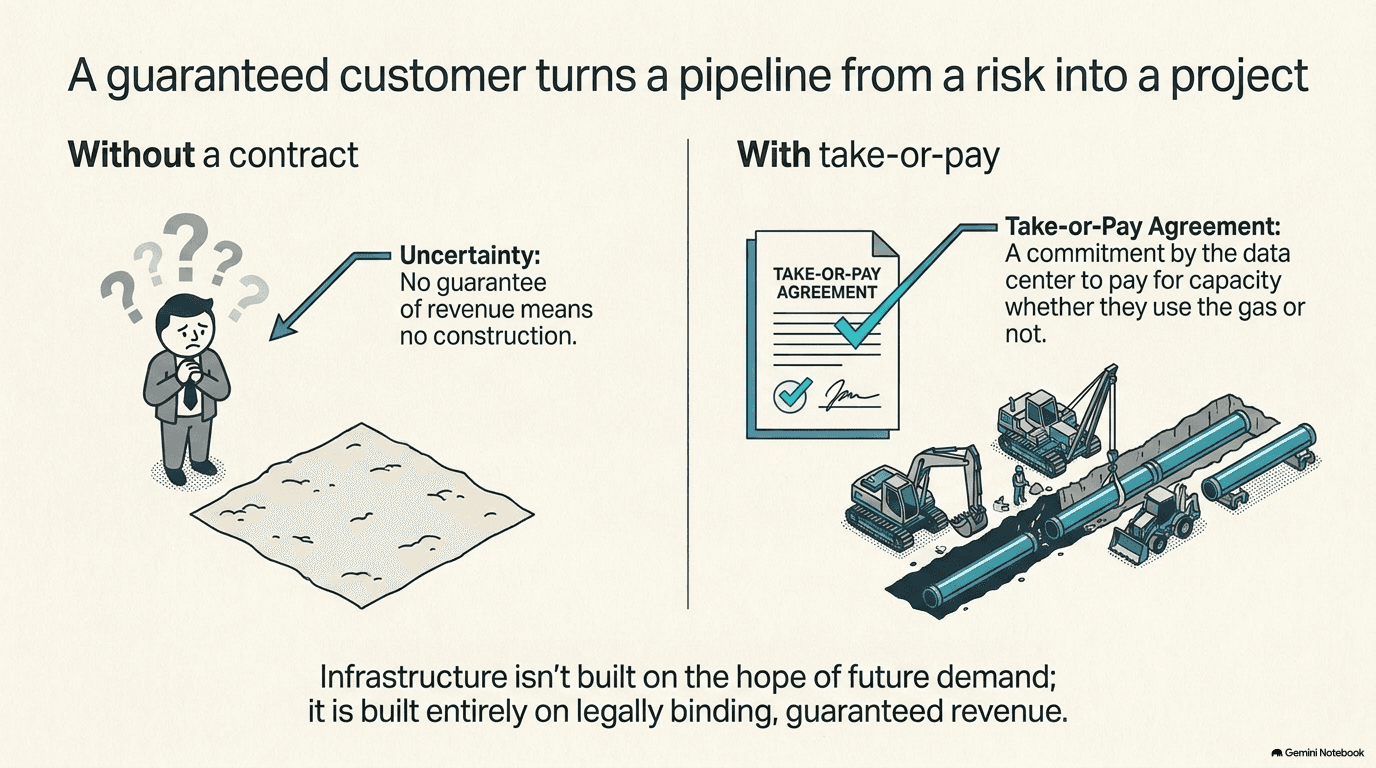
Building a new, large-diameter pipeline segment is an expensive, multi-year undertaking, and a pipeline company doesn't want to spend that money without certainty that someone will actually use the pipe once it's built. The mechanism that provides that certainty is a take-or-pay contract: the customer — in this case, a data center operator, or the operator of the gas turbines serving one — commits to paying for a guaranteed minimum volume of gas capacity over a long period, whether it actually uses all of that gas or not.
This is similar in spirit to signing a long lease on an apartment: you pay the rent whether you're home every night or traveling half the month. For the pipeline company, a take-or-pay contract turns an uncertain, speculative pipeline project into one with a guaranteed revenue floor, which is exactly the kind of certainty needed to justify spending years and substantial capital laying new steel in the ground. It's the gas-industry cousin of the long-term power purchase agreements described in Chapter 7 and section 8.2 — different fuel, same underlying logic: lock in a customer first, build the infrastructure second.
The scale of the shift
US natural gas demand forecasts have been revised sharply upward in recent years, with projections now pointing toward roughly 150 billion cubic feet of gas consumed per day by 2031 — driven substantially by new gas-fired power generation, much of it tied to data center growth. A billion cubic feet is an almost meaninglessly large number on its own; what matters is the direction and the driver. For decades, US natural gas demand from the power sector grew slowly, if at all, as efficiency gains and the growth of renewables offset rising electricity use. Data centers are now one of the clearest new sources of demand growth in the industry's forecasts — a fuel chain built for a different era of electricity is being asked to carry a new and fast-growing load, in parallel with the electrical grid described in section 8.1.
Water — The Second Lifeline
Chapter 5 explained what water does once it's inside a data center: it absorbs heat far more efficiently than air, whether flowing through cold plates bolted to a chip, circulating through a building's cooling loop, or evaporating in a cooling tower to reject heat to the outside air. This section is shorter, and covers a different question — where does that water actually come from, and why is getting it sometimes hard?
The supply side
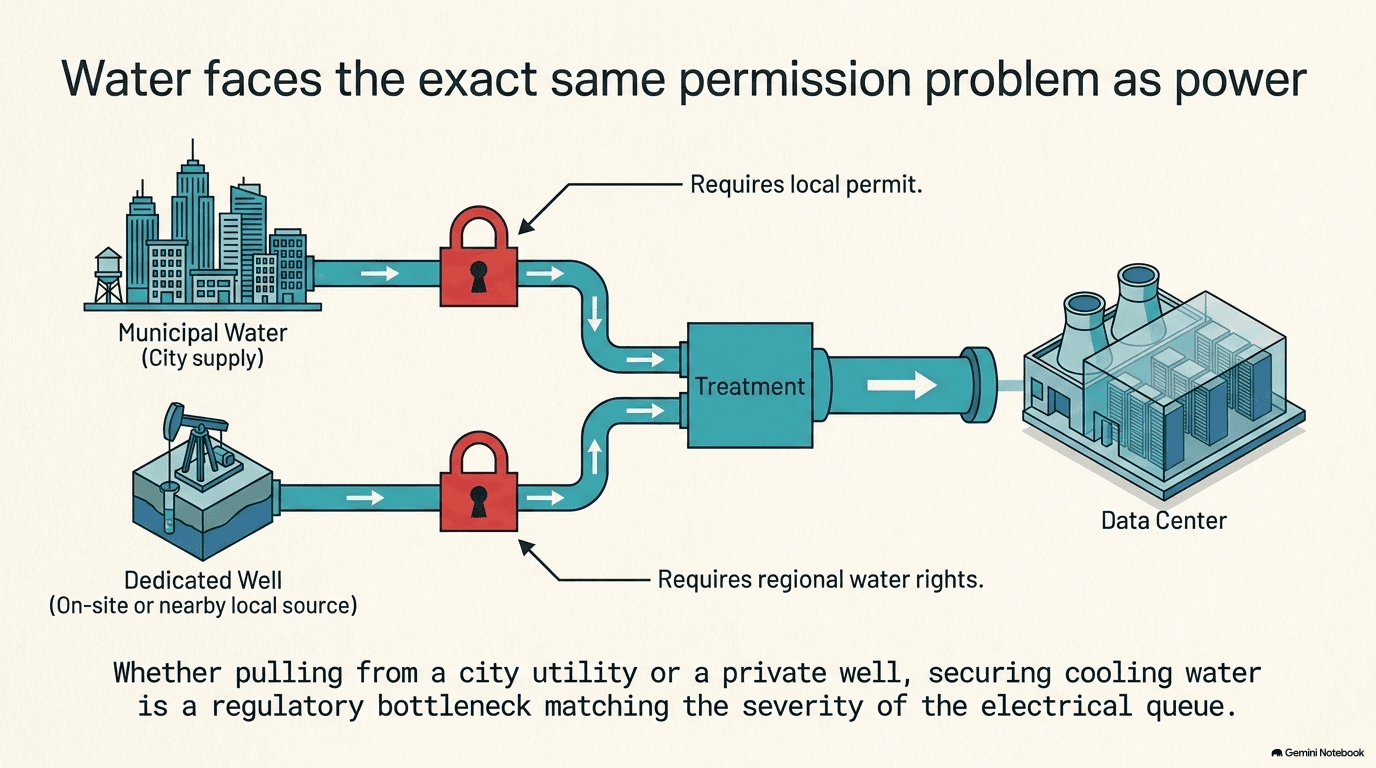
Most data centers draw their water from the same source as the surrounding community: the local municipal water supply — the same utility-run system that delivers water to homes and businesses. In some cases, particularly for larger or more remote campuses, an operator instead relies on dedicated wells that pump groundwater directly, or arranges its own water source such as a nearby reservoir or river intake, sometimes building its own small-scale treatment infrastructure to make that water usable.
Either way, using water at the volumes a large data center's cooling system requires (as described in Chapter 5) isn't simply a matter of turning on a tap. It typically requires a water right or permit — legal permission, usually issued by a state or local water authority, to withdraw a specific volume of water from a specific source. This is conceptually similar to the electrical interconnection study described in section 8.1: before you can use a shared resource at scale, the entity that manages that resource has to confirm there's enough to go around, and formally grant you a share of it.
A site selection constraint, not just an engineering one
Chapter 4 covered site selection factors like power availability, land cost, and climate. Water access belongs on that same list. In regions where water is already scarce or contested — arid parts of the American Southwest, for example, or areas experiencing prolonged drought — a data center's water demand can become a genuine point of local tension, competing directly with agriculture, other industry, and residential use for a limited and sometimes shrinking supply. A project that looks straightforward on the power and fiber side (both covered elsewhere in this chapter) can stall entirely if local water regulators, or local communities, push back on the volume being requested.
This is why cooling system design (Chapter 5) and site selection (Chapter 4) increasingly loop back to water availability as a hard constraint rather than a minor logistical detail. A design that uses less water — favoring, for instance, air-cooled chillers or dry coolers over evaporative cooling towers, at some cost in energy efficiency — can sometimes be the difference between a project that gets approved and one that doesn't, in a water-stressed location.
The Fiber-Optic Backbone — Connecting to the World
Everything described so far in this chapter — grid power, gas fuel, water — keeps a data center physically running. None of it matters if the data center can't actually move information in and out. A building full of the fastest chips in the world, with no connection to anything outside its own walls, is a very expensive and very useless room. The fiber-optic backbone is what solves that problem: a network of glass cables connecting the data center to every other data center, every internet exchange point, and ultimately every device on Earth trying to reach it.
The same glass, stretched across continents
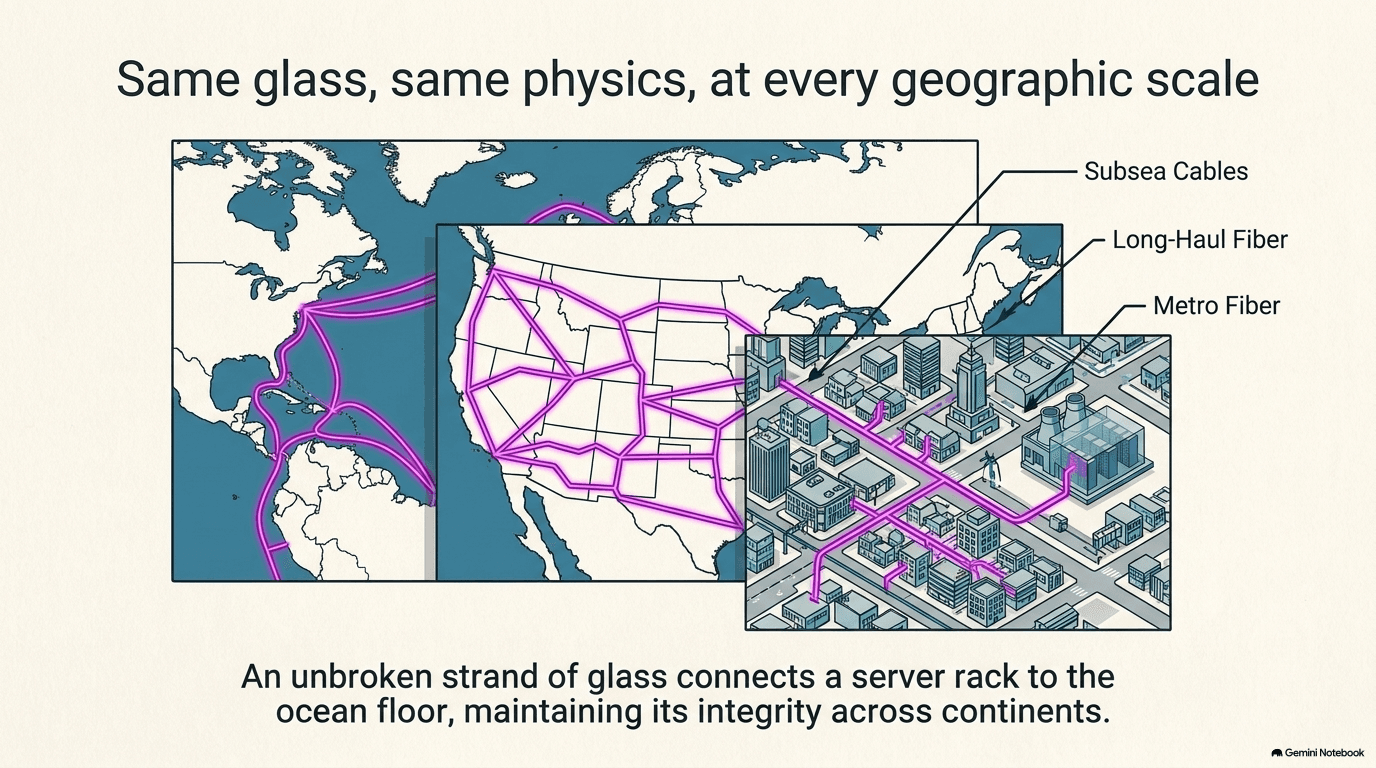
Chapter 3 explained how fiber-optic cable works inside and around a data center: light travels down an incredibly thin strand of ultra-pure glass, bouncing endlessly down the strand's length through a phenomenon called total internal reflection — the light hits the boundary between the glass core and its outer cladding layer at an angle so shallow that it reflects back inward every time, rather than escaping, letting it travel enormous distances with very little loss. That is the exact same underlying technology used here — the only difference is scale. Inside a data center, fiber runs a few meters between a switch and a server. Stretched across the outside world, that same technology runs thousands of miles between cities, and — via cables laid along the ocean floor — between continents.
The backbone has three rough layers, similar in spirit to the grid's generation-transmission-distribution structure from section 8.1: long-haul fiber connects major cities to each other across a country. Metro fiber is the shorter-range network within and around a single city, connecting individual buildings — including data centers — to the long-haul network. And subsea cables are the fiber-optic lines laid along ocean floors, connecting continents to each other; a message sent from a data center in Virginia to a user in Europe very likely passes through one of these undersea cables at some point in its journey.
Dark fiber versus lit fiber
When a company needs a fiber connection, it generally has two options, and the distinction matters enough to be worth defining carefully. Dark fiber is a raw, unused glass strand, leased or sold to a customer, who then supplies and operates its own equipment (the lasers and receivers that actually turn electricity into light and back again, as described in Chapter 3) to "light it up" — hence the name for an unused strand: it's dark because no light is traveling through it yet. Lit fiber, by contrast, is a service: the fiber provider owns and operates all the equipment itself, and simply sells the customer a data connection of a certain speed, the way an internet service provider sells a household a connection without the household needing to understand or manage any of the underlying hardware.
A large hyperscaler or data center operator with the technical staff and scale to justify it might lease dark fiber and run its own equipment, giving it maximum control and the ability to upgrade its own gear on its own schedule. A smaller operator is more likely to simply buy lit fiber as a service, the way most businesses buy an internet connection rather than build a private one.
The meet-me room: where outside meets inside
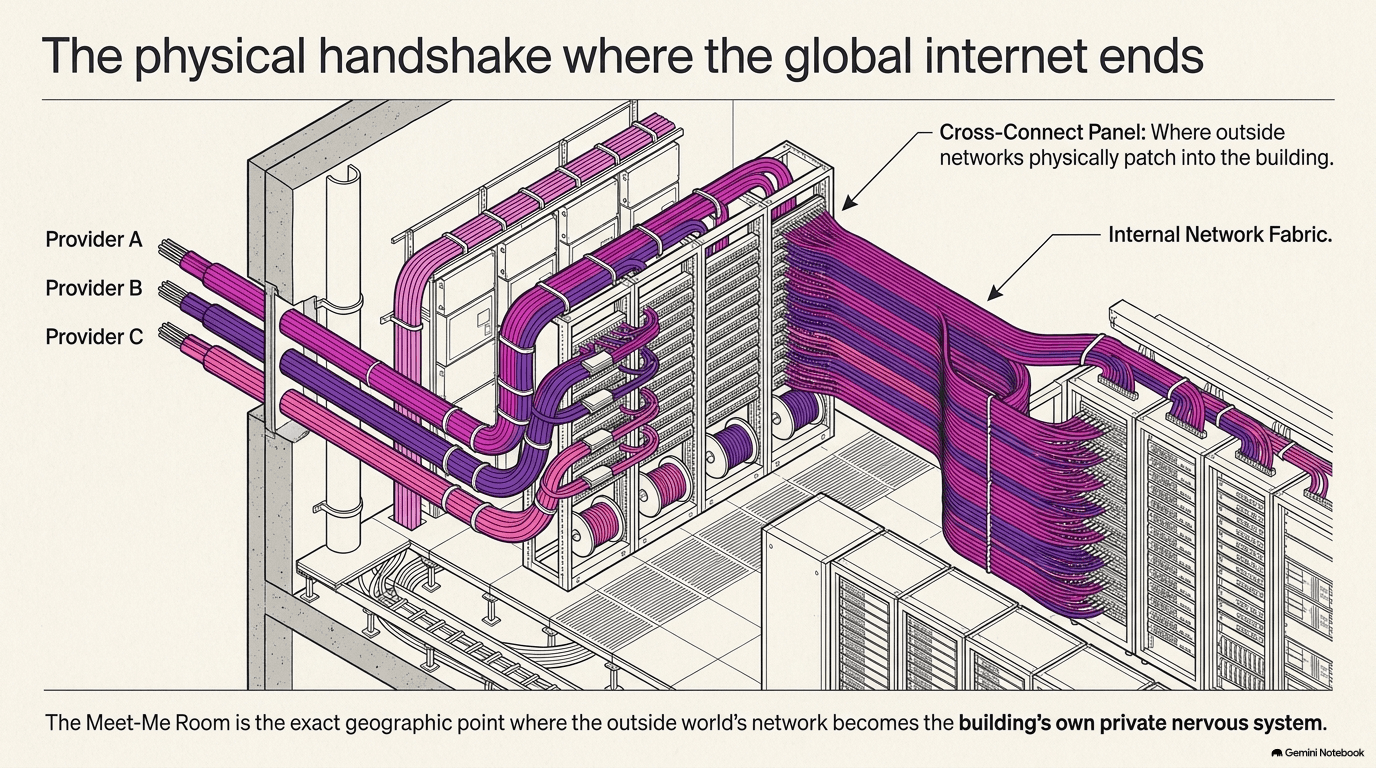
Chapter 4 introduced the meet-me room as one of the specialized spaces inside a data center building — the physical room where cables from outside network providers terminate and connect into the data center's own internal network. It's worth returning to here because it's the literal hinge point between everything in this chapter and everything inside the building. Picture it as a border crossing: fiber cables from multiple different outside network operators — sometimes a dozen or more competing providers — all arrive at this one room, where they're cross-connected into the building's internal switching fabric (Chapter 3). A data center with a well-connected meet-me room, serving many outside network operators, is more valuable and more useful to its tenants than one that has only a single outside connection, for the same reason a well-connected airport hub is more useful than an airport served by only one airline.
Why proximity to fiber shapes site selection
Chapter 4 listed fiber connectivity among the handful of major factors that determine where a data center gets built, alongside power and water. The reasoning is straightforward: laying brand-new long-haul fiber to a remote location is itself a slow, expensive construction project, not unlike building a new road. A site that already sits near existing fiber routes — often along the same corridors as highways or rail lines, since those existing rights-of-way make trenching cable cheaper — can be connected to the outside world far faster and cheaper than a site that requires new fiber built from scratch. This is one reason data centers cluster in a relatively small number of established markets rather than spreading evenly across the map: those markets already have the fiber, the power, and the water in place, in the combination described across this chapter and Chapter 4.
Who operates these networks
Lumen operates one of the largest fiber-optic networks in North America, including long-haul routes connecting major cities and metro networks reaching directly into many data center buildings. American Tower, primarily known for owning cell phone towers, also operates a business called CoreSite that runs a set of highly interconnected data centers — facilities specifically designed around having many outside network providers meet inside them, maximizing the value of the meet-me-room concept described above. Uniti Group operates a national fiber network, providing the long-haul and metro connectivity that links data centers and other customers across the country.
These networks were built, largely, for a previous generation of internet and telephone traffic — email, web browsing, video streaming, voice calls. AI has begun pouring a dramatically larger volume of data through the same physical cables: training a large AI model requires shuttling enormous datasets between storage systems and data centers, and increasingly, a single AI task is split across GPUs sitting in more than one physical location, requiring high-speed connections between buildings that didn't previously need to talk to each other this intensively. The glass itself hasn't changed since Chapter 3 explained it. What's changed is how much is being pushed through it.
Subsea cables illustrate this pressure especially clearly. A cable laid along an ocean floor is a singular, expensive, years-long engineering project — a specialized ship spools thousands of miles of armored fiber-optic cable off its stern, laying it carefully along a pre-surveyed route on the seabed, sometimes burying it under the ocean floor near shorelines to protect it from ship anchors and fishing equipment. Once laid, a subsea cable typically carries traffic for well over a decade. There is no quick way to add another one; a new cable means another dedicated ship, another survey, another multi-year project. When AI training data needs to move between a data center on one continent and one on another, it is very likely traveling through one of a limited number of these cables — a physical chokepoint at the bottom of the ocean, similar in spirit to the concentrated inland fiber routes described above.
Three Lifelines, All Strained at Once
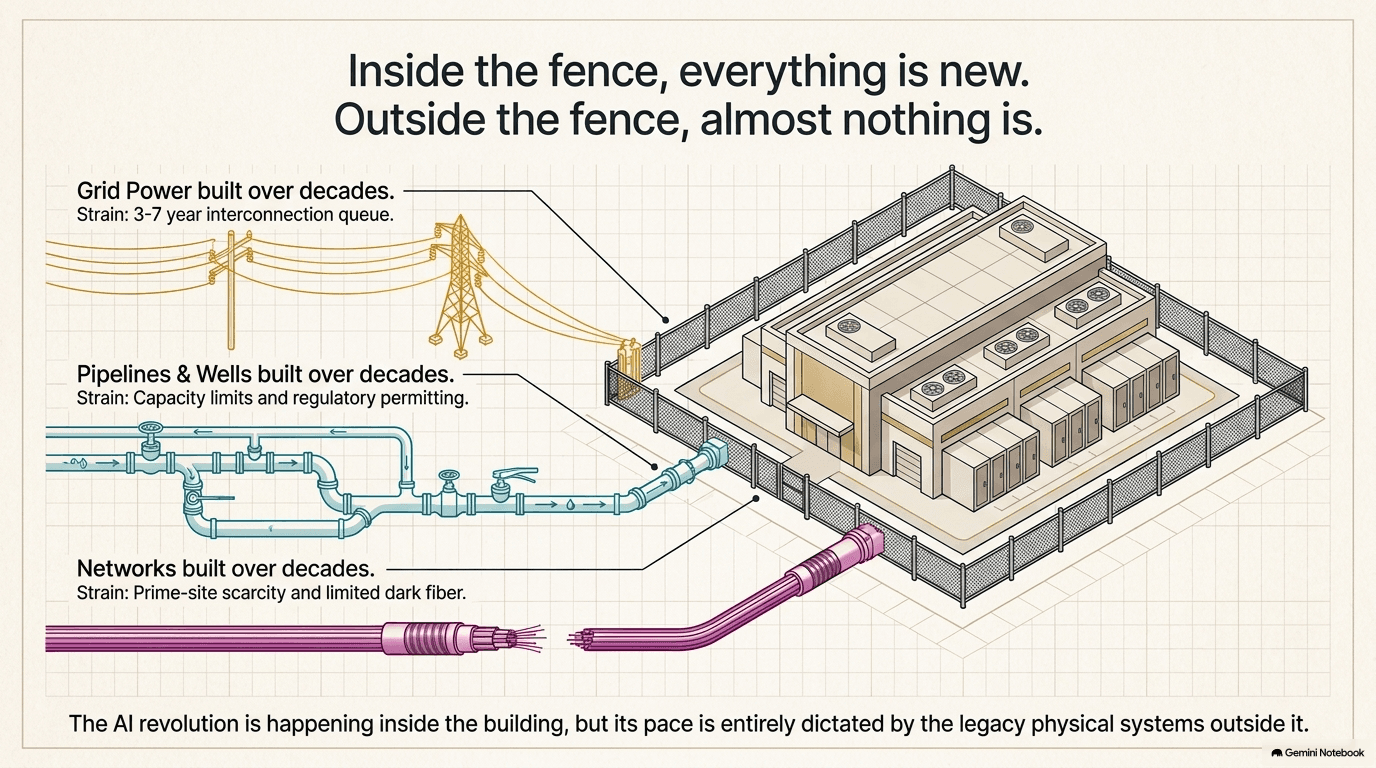
Step back, and a pattern emerges that connects this entire chapter. The electrical grid (section 8.1), the natural gas pipeline network (section 8.3), and the fiber-optic backbone (section 8.5) are three of the largest physical networks ever built by human beings. Each took the better part of a century to construct, mile by mile and pipe by pipe and wire by wire. None of them were designed with AI data centers in mind, because for nearly the entire time they were being built, AI data centers didn't exist.
Now all three are being asked, at the same time, to absorb a new category of demand that is larger, faster-growing, and more geographically concentrated than almost anything they've previously had to handle. A single data center campus doesn't just need more electricity than a typical customer — as section 8.1 described, it may need as much power as a small city, delivered on a timeline of months rather than the years utilities have traditionally planned around. It doesn't just need more gas — section 8.3 described new pipelines being built and take-or-pay contracts being signed specifically because existing pipeline capacity in some areas is already spoken for. And it doesn't just need a fiber connection — it needs one of the best-connected buildings in its region, competing with every other data center for the same limited set of prime, fiber-rich, power-rich sites described in section 8.5 and Chapter 4.
None of these three networks can simply be expanded overnight. A new transmission line or substation upgrade takes years of engineering, permitting, and construction (Chapter 6, Chapter 9). A new pipeline segment takes years of the same. New long-haul fiber routes, while generally faster to build than the other two, still require physical trenching or, in some cases, entirely new subsea cable projects that take years from planning to completion. This is precisely why the interconnection queue introduced in section 8.1 — and revisited in full in Chapter 13 — has become one of the defining bottlenecks of the entire AI buildout: it isn't that any single piece of equipment is impossible to build, it's that building enough of everything, in the right places, on the timeline the industry wants, is a genuinely enormous undertaking.
This is also the thread that connects everything covered so far in this encyclopedia to what's still ahead. Chapters 1 through 7 described what happens inside the fence line — the chip, the server, the network, the building, the cooling, the power distribution, the on-site generation. This chapter is the reminder that none of it works in isolation. A data center's usefulness is bounded just as much by the capacity of the grid outside its walls, the gas reaching its turbines, the water reaching its cooling towers, and the fiber reaching its meet-me room, as it is by anything happening on the chip itself. Expanding all of that — the outside infrastructure, not just the inside equipment — simultaneously, across hundreds of projects and thousands of miles of wire and pipe and glass, is a job that takes years and an enormous amount of capital. That is exactly the subject of the two chapters that close this encyclopedia: Chapter 13 (The Queue), which follows the years-long wait to actually connect, and Chapter 14 (The Money), which follows what it costs to build all of this at once.
Next: Chapter 9 — The Factories (the factories that build everything in Chapters 1 through 8)
Companies in this part of the buildout: Utilities & Energy, Networking